#iww

9 posts · Last used 13d

Today in Labor History September 22, 1919: 400,000 steelworkers, in 50 cities, went on strike to protest intolerable working conditions. Union leaders believed that if they could organize the steel workers, it would lead to a massive wave of unionization across the country. Thus began the Great Steel Strike of 1919. The bosses, however, were able to turn public opinion against the workers by calling them Communists and immigrants. They attacked strike organizer William Z. Foster as a revolutionary syndicalist and Wobbly (IWW). They hired Pinkertons, who kicked out any workers who came from out of town to support the strike. And they got local governments to shut down meeting halls on the grounds of health and safety violations. Ultimately, they called upon federal troops, which helped crush the strike after 3½ months, killing several workers, and imprisoning hundreds. However, the leadership of the American Federation of Labor also doomed the strike. Their racist, nativist, and disdainful views toward the increasingly immigrant workforce, and their autocratic strategies, alienated many of the workers. And U.S. Steel’s labor spies within the workforce were quick to exploit and deepen the riffs these attitudes and tactics produced among the workers. #workingclass #LaborHistory #union #steel #strike #IWW #anarchism #communism #immigration #policebrutality #police #racism
3
0
8
0
Today in Labor History August 23, 1927: Sacco and Vanzetti, two Italian immigrant anarchists living in the U.S., were executed murder during a botched robbery in Boston. However, there was no evidence linking them to the crime. They both had alibis, too, including an official at the Italian consulate. Their trial was rife with racism and political bias. The judge, Webster Thayer, said the following about Vanzetti: "This man, although he may not have actually committed the crime attributed to him, is nevertheless morally culpable, because he is the enemy of our existing institutions." The jury foreman, who was a former cop, said he didn’t care if they were innocent: "Damn them. They ought to hang anyway." The author, John Dos Passos, who came to Boston to cover the trial as a journalist, was arrested at a solidarity protest along with writer Dorothy Parker. Einstein, H.G. Wells, and Bernard Shaw all appealed for Sacco and Vanzetti lives. The IWW called for a 3-day nationwide General Strike, which was heeded by 1,132 out of the 1,167 miners in Colorado’s Walsenburg coal district, leading to the Colorado coal strike of 1927. The day after their execution, there were violent demonstrations around the world, including in Tokyo, Geneva, London, and Paris. In South America, wildcat solidarity strikes completely shut down many factories. In Germany, 3 protesters were shot dead. In Boston, over 200,000 came to the funeral procession. Upton Sinclair’s novel, “Boston,” explores the trial, and Vanzetti's life. Woody Guthrie recorded a series of songs known as the Ballads of Sacco & Vanzetti. In 1971, Joan Baez recorded her song "Here's to You," with music composed by Ennio Morricone, a tribute to Sacco & Vanzetti that went on to become a symbol for the human rights movement of the 1970s. #workingclass #LaborHistory #anarchism #saccoandvanzetti #IWW #coal #miners #strike #generalstrike #solidarity #riot #author #writer #books #fiction @bookstadon@a.gup.pe
39
5
55
1
Today in Labor History July 26, 1877: Federal troops killed up to 30 workers at the "Battle of the Viaduct," Chicago, during the Great Upheaval (AKA Great Train Strike). This came after the Workingmen’s Party (affiliated with the First International), organized a rally of six thousand people. At this gathering, a former Confederate Army Officer from Waco, Texas, named Albert Parsons, gave a fiery speech. The events of the Great Upheaval radicalized Parsons and his wife Lucy. In the years following it, they became some of the nation’s leading anarchist organizers. The state executed him in 1887 as one of the Haymarket Martyrs who had been fighting for the eight-hour workday. His widow, Lucy, an African American woman, went on to cofound the radical Industrial Workers of the World, in 1905, along with Mother Jones, Eugene Debs, Big Bill Haywood, and others. The day after Parsons’ speech, protests erupted. Police fired into the crowd, killing three men. The next day, an armed demonstration of 5,000 workers fought the police and soldiers in the Battle of the Viaduct, when they killed as many as 30 more workers and injured over one hundred. One journalist wrote, “The sound of clubs falling on skulls was sickening for the first minute, until one grew accustomed to it. A rioter dropped at every whack, it seemed, for the ground was covered with them.” A judge later found the police guilty of preventing the workers from exercising their right to freedom of speech and assembly The Great Upheaval was a national strike wave involving major uprisings in Martinsburg, WV, Baltimore, Pittsburgh, Saint Louis, San Francisco, Boston, Reading, PA, New York and many other cities. I write about it in my historical “Great Upheaval Trilogy.” My first book, “Anywhere But Schuylkill,” takes place in the years immediately preceding the Great Upheaval. Book II, “Red Hot Summer in the Smoky City,” my current WIP, takes place in Pittsburgh, at the height of the Great Upheaval. You can read my complete article about the Great Upheaval here: https://michaeldunnauthor.com/2024/03/31/the-great-upheaval/ You can read my biography of Lucy Parsons here: https://michaeldunnauthor.com/2024/03/24/lucy-parsons/ And you can get my book ANYWHERE BUT SCHUYLKILL from these indie book sellers: https://www.keplers.com/ https://www.greenapplebooks.com/ Or send me $25 via Venmo (@Michael-Dunn-565) and your mailing address, and I will send you a signed copy! #workingclass #LaborHistory #chicago #massacre #railroad #GeneralStrike #wildcat #strikewave #IWW #socialism #haymarket #anarchism #lucyparsons #policebrutality #policemurder #fiction #novel #historicalfiction #writer #author #books @bookstadon@a.gup.pe
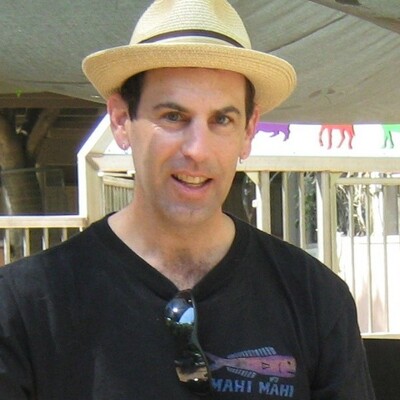
10
1
6
0
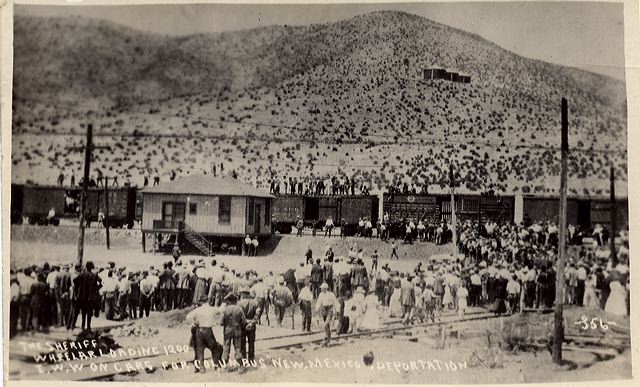
Today in Labor History July 12, 1917: The Bisbee Deportation began, the illegal kidnapping and deportation of 1,300 mostly immigrant copper miners from Bisbee, Arizona. The miners were members of the Industrial Workers of the World (IWW, or Wobblies), on strike against the Phelps Dodge mining company. They were held in the town’s baseball park, before being sent by train, without food or water, to the New Mexican desert 200 miles away. Some of the railcars were covered in manure three inches deep. The temperature for the 16-hour ride was in the mid-90s. The authorities threatened to lynch any of them that returned. They were then taken to Columbus, NM, which was still under U.S. military occupation, in hopes that the soldiers there would attack the Wobblies. The U.S. soldiers were there to secure the town, after having battled Pancho Villa and 500 Mexican rebels the previous year. The IWW had called for a strike to begin on June 26. More than 3,000 miners participated, including workers from all the local mines (not just Phelps Dodge), or about 85% of all mine workers in Bisbee. Cochise County Sheriff Harry Wheeler asked the Governor to request federal troops: "The whole thing appears to be pro-German and anti-American." On July 10, Phelps Dodge President Walter Stuart Douglas formed “Citizens Committee” made up of local business leaders. They rounded up over 100 Wobblies in Jerome, Arizona and deported 67 of them from to Needles, California. They told them to never return. When the IWW protested to the Governor, he claimed that they had "threatened" him. On July 11, authorities in Bisbee sealed off the county and seized the local Western Union telegraph office and cut off outside communication, while the sheriff and mine owners organized a posse of 2,000 well-armed vigilantes began. They arrested Wobblies, as well as sympathetic towns people and several shop owners. Over 2,000 men, in total, were arrested. Jim Brew, IWW member and a veteran of the violent West Virginia Cripple Creek strike of 1903-04, fought back and killed Deputy Sheriff Orson McRae. Three other deputies promptly shot him dead. 25% of the deportees were Mexican and many of them were members of the Partido Liberal Mexicano (PLM), an anarchist organization created by Ricardo Flores Magon. The IWW and PLM had longstanding ties. Numerous Anglo IWW members joined the Magonistas when they invaded and occupied Baja California, early in the Mexican Revolution. Many workers in Arizona held dual membership in the two organizations, including Rosendo Dorame, who appears in the film Bisbee 17. Another of the Bisbee deportees was Kurt Wilckens, an anarchist immigrant from Germany, and an IWW member. In 1920, the authorities deported him back to Germany under the Espionage Act for making antiwar statements. However, he immediately left for Argentina, where he participated in the Patagonian Uprising (1920-22). During that revolt, the military, led by Lieutenant Colonel Héctor Benigno Varela, slaughtered 1,500 workers. To avenge the workers killed, Wilckens bombed and shot Varela. His jailers assassinated him in jail. The workers responded with a General Strike. You can read my full article on the Bisbee Deportation here: https://michaeldunnauthor.com/2026/06/01/the-bisbee-deportation/ #workingclass #LaborHisotry #IWW #bisbee #bisbeedeportation #immigration #racism #unionbusting #vigilantes #copper #mining #arizona #ricardofloresmagon #magonista #anarchism #generalstrike
8
0
13
1
Today in Labor and Writing History July 10, 1917: The Jerome Deportation occurred in Arizona. On July 5, IWW workers struck at Phelps Dodge mines, in Jerome, Az. Mine supervisors, along with a hastily formed “Citizens Committee” made up of local business leaders, rounded up and deported over 100 Wobblies (IWW members) to Needles, CA, and told them to never return. Two days later, after seeing how successful they had been in Jerome, they launched an even bigger deportation in Bisbee, Az. This time, they rounded up roughly 2,000 Wobblies from the Phelps Dodge mines in Bisbee, Az, and deported them to New Mexico. “Bisbee ‘17,” (1999) by Robert Houston, is a historical novel based on the Bisbee deportations. There was also a really interesting film of the same name that came out in 2018. In the film, the town’s inhabitants reenact the events of the Bisbee deportation 100 years later. It also includes interviews with current residents. #workingclass #LaborHistory #union #strike #IWW #wobblies #bisbeedeportation #mining #arizona #vigilantes #film #book #novel #writer #author #HistoricalFiction @bookstadon@a.gup.pe
1
0
2
0
Replying to
After finishing my 32nd book of the year, my next ebook will Joe Hill: The IWW & the Making of a Revolutionary Working Class Counterculture by Franklin Rosemont #CurrentlyReading #Goodreads #ReadingChallenge #Bibliophile #Booklovers #Bookworm #Kindle #ebook #JoeHill #IWW #Wobbly #Wobblies #DontMournOrganise #Socialism #Socialist #TradeUnions
1
4
0
0
You've seen all posts