Today in Labor History August 23, 1927: Sacco and Vanzetti, two Italian immigrant anarchists living in the U.S., were executed murder during a botched robbery in Boston. However, there was no evidence linking them to the crime. They both had alibis, too, including an official at the Italian consulate. Their trial was rife with racism and political bias. The judge, Webster Thayer, said the following about Vanzetti: "This man, although he may not have actually committed the crime attributed to him, is nevertheless morally culpable, because he is the enemy of our existing institutions." The jury foreman, who was a former cop, said he didn’t care if they were innocent: "Damn them. They ought to hang anyway."
The author, John Dos Passos, who came to Boston to cover the trial as a journalist, was arrested at a solidarity protest along with writer Dorothy Parker. Einstein, H.G. Wells, and Bernard Shaw all appealed for Sacco and Vanzetti lives. The IWW called for a 3-day nationwide General Strike, which was heeded by 1,132 out of the 1,167 miners in Colorado’s Walsenburg coal district, leading to the Colorado coal strike of 1927. The day after their execution, there were violent demonstrations around the world, including in Tokyo, Geneva, London, and Paris. In South America, wildcat solidarity strikes completely shut down many factories. In Germany, 3 protesters were shot dead. In Boston, over 200,000 came to the funeral procession. Upton Sinclair’s novel, “Boston,” explores the trial, and Vanzetti's life. Woody Guthrie recorded a series of songs known as the Ballads of Sacco & Vanzetti. In 1971, Joan Baez recorded her song "Here's to You," with music composed by Ennio Morricone, a tribute to Sacco & Vanzetti that went on to become a symbol for the human rights movement of the 1970s.
#workingclass #LaborHistory #anarchism #saccoandvanzetti #IWW #coal #miners #strike #generalstrike #solidarity #riot #author #writer #books #fiction @bookstadon@a.gup.pe
#miners
3 posts · Last used Aug 23
Today in Labor History July 27, 1918: Miner and union organizer Ginger Goodwin was shot by a hired private cop outside Cumberland, British Columbia sparking Canada's first General Strike. He was a labor activist and a member of the Socialist Party of Canada. Additionally, he was an antiwar activist who said that workers of one country should not be employed to kill workers of another country because of capitalist conflict. “War is simply part of the process of Capitalism,” he said. “Big financial interests will reap the victory, no matter how the war ends.” However, in spite of his protests, he was still drafted to fight in the First World War. In order to avoid conscription, he fled into the mountains, where he was murdered by a cop in 1918. Canada’s first General Strike began in response.
https://youtu.be/GrwUueuW6rs
The Ballad Of Ginger Goodwin
Ginger Goodwin is a name you don't often hear or see.
They don't say a word about him in our country's history.
He was a labour leader and he wouldn't go to war.
"While the army breaks our strikes at home, its strikers I'll fight for."
In Trail back in the summer of 1917.
Ginger fought against conscription even though he was class D.
But when he led a miners' strike to spread the eight hour day
Conscription checked him out again and found he was class A.
Ginger hid from cops and soldiers in the hills near Cumberland.
Miners brought him food and sheltered him, they knew he was their friend.
So the bosses hired special cops when their power was at stake.
Dan Campbell murdered Goodwin at the head of Comox Lake.
The whole damn town of Cumberland turned out for the funeral hike.
Vancouver's workers shut her down for a one day general strike.
Soldiers back from foreign wars then attacked the labour hall.
Both the bosses and the workers knew who caused the Czar's downfall.
You can still see Ginger's grave along the road to Cumberland.
He didn't win no medals and no one understands.
Don't tell me that a hero has to die in foreign lands.
We lost heroes here in labour's wars and they all had dirty hands.
#workingclass #LaborHistory #gingergoodwin #canada #union #strike #miners #antiwar #police #policebrutality #folkmusic #generalstrike #socialism #onebigunion
Enoch Kent - The Murder Of Ginger Goodwin
Today in Labor History July 1, 1983: Copper miners began a strike against Phelps-Dodge in Clifton, Arizona. During the strike, company-owned railroad bridges were set on fire and strikers smashed windows of scab vehicles. Governor Bruce Babbitt repeatedly sent in state police and National Guardsmen to suppress and ultimately crush the 3-year-long strike. Replacement workers then voted to decertify the union in the largest mass decertification in U.S. history. 35 locals of 13 different unions representing Phelps-Dodge workers were all decertified. Within a couple of years, their profits skyrocketed 15-fold to $420 million per year. This was one of the most effective and historically significant union-busting campaigns of the post-WWII era, along with the PACTCO strike, and Reagan’s mass-firing of the air traffic controllers in 1981.
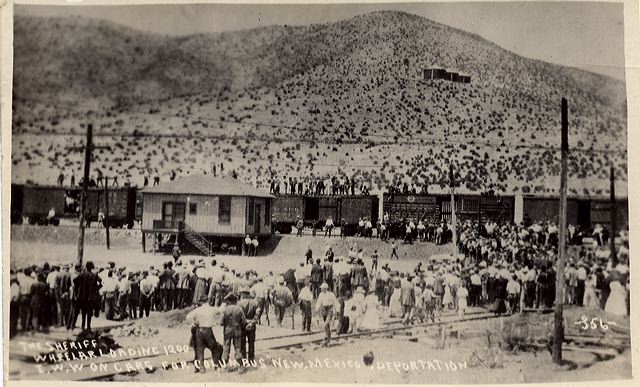
Phelps-Dodge was also the largest copper mine owner in Bisbee, Arizona, just 180 miles to the south of Clifton. In 1917, during an IWW strike against the copper mines, Phelps-Dodge created a posse of vigilantes that illegally arrested and deported 1,300 mostly immigrant copper. 25% of the deportees were Mexican and many of them were members of the Partido Liberal Mexicano (PLM), an anarchist organization created by Ricardo Flores Magon, and had participated in the anarchist uprising that conquered much of Baja California in.
You can read more about the Bisbee Deporation here: https://michaeldunnauthor.com/2026/06/01/the-bisbee-deportation/
#workingclass #LaborHistory #copper #miners #arizona #unionbusting #union #strike #police #policebrutality #phelpsdodge #patco #Reagan #scabs #anarchism #ricardofloresmagon #iww #bisbee #deportation #immigration
You've seen all posts
