#debt

25 posts · Last used 8d

Back to Timeline
Global News National @glnational_mirror@mastodon.hongkongers.net · Aug 06, 2026
Consumers using savings to pay for essentials and piling up debt: Equifax Canadians continue to face financial strain amid the heightened cost of living, according to the latest report from Equifax, which shows younger people generally struggle the most. #Canada #Consumer #Money #Affordability https://globalnews.ca/news/12011352/consumers-affordability-savings-debt-equifax/
0
0
0
Global News @glnews_mirror@mastodon.hongkongers.net · Aug 06, 2026
Consumers using savings to pay for essentials and piling up debt: Equifax Canadians continue to face financial strain amid the heightened cost of living, according to the latest report from Equifax, which shows younger people generally struggle the most. #Canada #Consumer #Money #Affordability https://globalnews.ca/news/12011352/consumers-affordability-savings-debt-equifax/
0
0
0
Global News Money @glmoney_mirror@mastodon.hongkongers.net · Aug 06, 2026
Consumers using savings to pay for essentials and piling up debt: Equifax Canadians continue to face financial strain amid the heightened cost of living, according to the latest report from Equifax, which shows younger people generally struggle the most. #Canada #Consumer #Money #Affordability https://globalnews.ca/news/12011352/consumers-affordability-savings-debt-equifax/
0
0
0
Global News Canada @glcanada_mirror@mastodon.hongkongers.net · Aug 06, 2026
Consumers using savings to pay for essentials and piling up debt: Equifax Canadians continue to face financial strain amid the heightened cost of living, according to the latest report from Equifax, which shows younger people generally struggle the most. #Canada #Consumer #Money #Affordability https://globalnews.ca/news/12011352/consumers-affordability-savings-debt-equifax/
0
0
0
your auntifa liza 🇵🇷 🦛 🦦 @blogdiva@mastodon.social · Aug 02, 2026
Replying to @blogdiva@mastodon.social
so it should be clear then that #ManifestDestiny is a secularization of the #DivineRight to rule claimed by nobilities. and it should explain why #blanqueamiento and #ManifestDestiny were ok with the millions of europeans migrating after 1898 regardless of their “limpia” status. mass migration satisfied their goal of killing off and expropriating as many afro/indigenous people across the Américas as possible & repopulating with #DEBT SLAVES, aka indentured workers 🧵…
13
1
8
your auntifa liza 🇵🇷 🦛 🦦 @blogdiva@mastodon.social · Jul 31, 2026
Boosted by Trending Bot @trending@homestead.social
RE: https://thelounge.network/@LogicalApex/117015592498964606 indentured servitude is #slavery by #debt. #healthCare tied to #employment is an engineered debt. the usa health care by employment is a form of indentured servitude. in other words: EMPLOYMENT IN THE UNITED STATES IS A FORM OF DEBT SLAVERY. doubly so if you have debt by #studentLoans. #PuertoRico outlawed debt slavery because post-slavery plantation workers were locked into their jobs by debt ―always to the plantation owner― they couldn’t retire in bankruptcy. like today's student loans.
Quoting
Frazell Thomas @LogicalApex@thelounge.network
RE: https://mstdn.social/@DemocracyMattersALot/117015564383055179 This is the main reason employers don't want fundamental changes to the US healthcare system. Their share of the costs has increased heavily over the last two decades, but they love its impact on employee retention. This is a feature not a bug. #healthcare #affordableHealthCare
Open quoted post
12
0
26
Erik Jonker @ErikJonker@mastodon.social · Jul 30, 2026
Not surprising but worrying, it increases the chance of a hard financial crash of the AI bubble. Which will not only hurt tech companies. https://futurism.com/artificial-intelligence/ai-companies-hide-debt-off-balance-sheet #AI #bubble #financial #debt
7
0
8
Robin Forlonge Patterson @RFPatterson@mastodon.nz · Jul 29, 2026
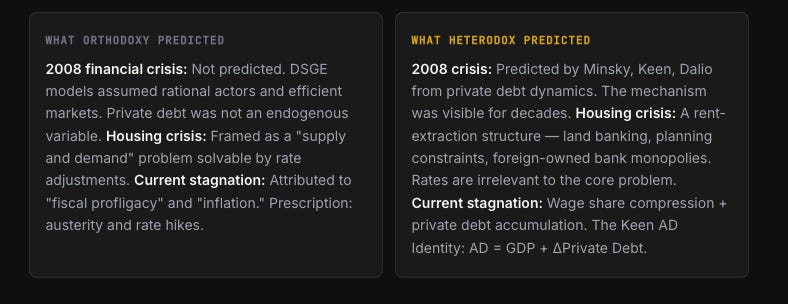
https://keenlens.substack.com/p/the-bank-of-england-admitted-in-2014 'I see everyday #politicians repeat like parrots #economic propositions they don't even start to understand, defending a model that a central #bank admitted was wrong over twelve years ago. ... The #Greens propose actual structural change and get labelled "communist" by people who have never read a balance sheet or a #Lenin text. The heterodox approach #predicted #2008, predicted the #housing #crisis, and predicted the current private #debt trap. The orthodox models predicted none of it ...' 'The orthodox model was declared wrong by the Bank of #England in 2014. Their paper “#Money Creation in the Modern Economy” stated plainly: #banks do not lend out deposited #reserves in a multiplier chain. Banks create #deposits when they make #loans ...' (NZ's Social Credit Party got a Court to agree five decades earlier.) 'The consequences are not theoretical or academic. When you worship the wrong model, you can’t do anything else than design the wrong #policy. You pretend not to see the #monopoly extracting over 6 billions from a #mortgage market they control 87% of. You don’t see that raising rates shift #income from #borrowers to banks and does not touch the supply of housing stock. You end up believing the #household metaphor is literal — that the Crown pockets are empty — when #NZ’s #Crown debt is 44% of #GDP...' (The OECD average is about twice that.) '... #Galileo was almost burned at stake for simply asking the #Inquisition #judges to look in the telescope. Same old, same old.' '..... 'Gentlemen, it is clear cut #class #warfare, and the #vested interests are so encrusted in #society that they are winning. Remember that their main weakness is in numbers, they are damaging and literally #robbing the majority of us, of the New Zealand society and brainwashing many trees to think that voting for the axe is the #prudent, #family sensible thing to do. The only chance you have is when numbers talk. The #election is coming...'
5
3
9
The Whore of Blahbylon @The_Whore_of_Blahbylon@mastodon.social · Jul 26, 2026
84
3
44
Don Curren 🇨🇦🇺🇦 @dbcurren.bsky.social@bsky.brid.gy · Jul 23, 2026
1 Bloomberg: The US #30-year #bondyield has held above 5% for the longest stretch since the dawn of the financial crisis, echoing investor concerns about a growing #debt pile and sticky #inflation. 🧵 #bonds #yields
0
1
0
MediaFaro Analysis @mf_analysis@mastodon.mediafaro.org · Jul 21, 2026
Where are Europe’s households most indebted? Not where you would think. Europe’s household debt map reveals a surprising north-south divide. Discover the latest Eurostat figures and the 10 most indebted countries. https://mediafaro.org/article/20260721-where-are-europes-households-most-indebted-not-where-you-would-think?mf_channel=mastodon&action=forward #HouseholdDebt #Europe #Debt #Mortgage #Economy #Germany #Portugal #Cyprus #Belgium #France #Luxembourg #Finland #Sweden #Denmark #Netherlands
3
2
1
Santa Clara County Dem Party @sccdp@sfba.social · Jul 19, 2026
The U.S. National Debt is approaching $40 trillion, nearly doubled from when Trump was first elected in 2016. Burdening future generations to fund tax cuts for billionaires and excessive military spending for pointless, endless wars, all while cutting healthcare and driving up the cost of living. #debt #nationaldebt #trump #gop #uspol
0
0
0
Centre for Nigeria Progress @lawakhigbe.com@lawakhigbe.com · Jul 17, 2026

BEAN TO BRAND, TARIFF TO TRAP by Lawson Akhigbe

Next in Abuja, four governments will do something that sounds, on paper, like a belated act of economic self-respect. Nigeria, Ghana, Côte d'Ivoire and Cameroon between them the source of roughly two-thirds of the cocoa that becomes the world's chocolate will sign the Abuja Declaration and stand up a Cocoa Value Addition Alliance, a coordinated attempt to stop shipping out raw beans and start capturing some of the value that currently accrues, almost entirely, to everyone else. Nigeria will additionally sign its own Cocoa Value Addition Accord, a domestic compact roping in governors, farmer groups, financiers and researchers into the project of turning bean into brand rather than bean into someone else's bar. Hover or focus to reveal Sensitive
My previous article on this subject https://lawakhigbe.com/2026/07/10/the-tariff-trap-how-africa-was-turned-into-a-warehouse-for-raw-materials-by-lawson-akhigbe/ How Africa’s Cocoa Rebellion Meets the West’s Oldest Trick Next in Abuja, four governments will do something that sounds, on paper, like a belated act of economic self-respect. Nigeria, Ghana, Côte d’Ivoire and Cameroon between them the source of roughly two-thirds of the cocoa that becomes the world’s chocolate will sign the Abuja Declaration and stand up a Cocoa Value Addition Alliance, a coordinated attempt to stop shipping out raw beans and start capturing some of the value that currently accrues, almost entirely, to everyone else. Nigeria will additionally sign its own Cocoa Value Addition Accord, a domestic compact roping in governors, farmer groups, financiers and researchers into the project of turning bean into brand rather than bean into someone else’s bar. It is, by any sober reading, the correct instinct. It is also, if history is any guide, about to run headlong into a wall that has been under construction in Brussels and Washington for considerably longer than the Alliance has existed. Call it Act One of a story whose ending the West has already written. ACT I: THE THEATRE OF ARRIVAL There is a genre of African policy announcement that specialises in the register of overdue justice, and the Cocoa Value Addition Summit has assembled a fine cast for it. The Minister of State for Industry, Senator John Owan Enoh a cocoa farmer himself, which lends the occasion the useful appearance of authenticity has reached for the century-old image of Africa sending beans out in sacks and receiving them back in wrappers, paying twice for the privilege. It is a good line. It is also, uncomfortably, a description of a trade architecture that nobody in Brussels or Washington built by accident. The summit’s stated priorities are sound enough: harmonised standards, a common negotiating position, coordinated compliance with the European Union’s Deforestation Regulation before it bites in December, and the headline item a serious push toward local processing, with Nigeria’s 70,000-tonne Sagamu plant offered up as proof the ambition has left the communiqué stage. Financing sessions with the Bank of Industry and the Nigeria Incentive-Based Risk Sharing System for Agricultural Lending suggest the money conversation is at least being had honestly. None of this is theatre for theatre’s sake. Cocoa prices have swung this past eighteen months from record highs above eleven thousand dollars a tonne down to roughly three thousand and back up toward five, a rollercoaster that four bean-exporting nations have had to ride with no seatbelt and no say in the fare. Value addition is not merely a development slogan; it is the only known cure for that particular vertigo. But there is an elephant standing in the conference hall in Abuja, and it will still be there after the Declaration is signed, the photographs taken, and the delegations flown home. ACT II: THE TARIFF STAIRCASE The West’s genius, historically, has never been in denying African countries market access. It has been in granting it selectively, by processing stage, in a structure economists politely call tariff escalation and everyone else might call a toll booth that only opens for the empty-handed. The European Union charges nothing at all on raw cocoa beans crossing its border. The moment those beans become cocoa powder, a tariff of roughly seven or eight per cent appears. Push further up the chain, toward chocolate crumb or finished confectionery, and the number climbs again. The pattern is not subtle: the EU wants Africa’s beans, not Africa’s chocolate, and it has built its border accordingly. This is not a conspiracy theory whispered in Lagos; it is published WTO schedule, sitting in plain sight for anyone who cares to read a tariff line. The effect over decades has been to freeze the cocoa-producing world in place supplying the raw material a continent away from where the profit is booked, subsidising, in effect, the very European confectionery industry that then sells the finished bar back at a markup Africa never sees a cent of. It is protectionism wearing the costume of free trade, and it has worked exactly as designed for roughly a hundred years, which happens to be precisely the span of injustice the Minister invoked in his own remarks, apparently without noticing he was standing inside the very structure he was denouncing. So the Alliance’s ambition to move up the value chain is not simply an economic development plan. It is a direct assault on a tariff wall that Europe has spent a century perfecting for exactly this contingency. Whether Brussels blinks first, or simply raises the toll, is the genuinely open question the summit’s communiqué is too polite to ask. ACT III: WASHINGTON JOINS THE AMBUSH If the EU’s tariff staircase were the whole story, it would already be a formidable obstacle. It is not the whole story. Over the past year Washington has layered its own tariff regime onto the same cocoa-exporting nations, and the numbers are not comforting reading in Abuja. Côte d’Ivoire, the world’s largest producer, was initially threatened with a levy above twenty per cent before it was talked down to fifteen; Ghana sits at ten. A baseline tariff now applies to most cocoa-exporting countries selling into the American market, even as Canada and Mexico which grow no cocoa of their own enjoy zero-duty access under their North American trade arrangement, simply by virtue of being neighbours rather than suppliers. The consequence, already visible in the trade data, is buyers rerouting purchases through Ottawa and Mexico City to dodge a tariff regime aimed, nominally, at the countries that actually grow the crop. It is a fairly elegant piece of self-defeating protectionism: American chocolate manufacturers pay more, American consumers pay more, and the West African farmer whose beans triggered the whole exercise gets none of the blame and less of the money. This is the second half of the pincer the new Alliance walks into. Just as four producing nations agree to stop exporting beans and start exporting chocolate, they discover that the two largest markets on earth have, independently and for entirely different domestic political reasons, made that exact transition more expensive than it was a year ago. ACT IV: THE LEVERAGE THAT ISN’T THERE Here is the part the Abuja Declaration cannot solve by itself, however well-drafted its clauses. A trade dispute is, at bottom, a negotiation between parties who can each hurt the other. The EU and the US can threaten African cocoa with tariffs because there is essentially no retaliatory currency on the other side of the table. Nigeria cannot meaningfully tariff European machinery or American pharmaceuticals in a way that would cost Brussels or Washington a winceworthy sum; the trade relationship is lopsided by design, and it has been lopsided for exactly as long as the tariff staircase has existed. Four cocoa-producing nations acting as a bloc gives them a stronger voice in setting standards and negotiating access genuinely useful, not nothing but a cartel of suppliers is not the same instrument as a cartel with pricing power, and cocoa, unlike oil, has no OPEC-style capacity to simply withhold supply and watch the other side sweat. The world can substitute a great deal before it will substitute chocolate, but it can wait out four countries with no fiscal reserves for a prolonged standoff rather more easily than those four countries can wait out it. This is the quiet asymmetry sitting underneath the summit’s language of dignity and redesigned positioning. Value addition raises the price of the fight without raising the ammunition available to fight it with. The EU Deforestation Regulation compliance deadline in December is itself a demonstration of the imbalance: Brussels sets the rule, on Brussels’ timeline, and Abuja’s alliance can only ask, politely, that smallholder farmers not be made to pay for a standard they had no hand in writing. None of which is an argument against the Alliance. Refusing to process cocoa because the tariff wall is unfair is simply agreeing to remain poor on schedule. But an honest reading of Tuesday’s Declaration would name the wall rather than merely gesture past it, and would treat the coordination among four producing nations as the opening move in a much longer contest over market access not the victory lap the press statements are already dressed for. The bean has waited a century for the brand. The tariff schedule has had just as long to prepare for the day it finally showed up.

4
0
1
WSJ.com — Markets @wsj_markets@robot.villas · Jul 16, 2026
0
0
0
Kim Perales @KimPerales@toad.social · Jul 11, 2026
"Despite concerns from debt hawks:🚨US govt is continuing to borrow: for the fiscal year of 2026 so far, the fed #deficit: totaled just under $1.4T. The 1st 9 months of this fiscal year (beg in Oct)🚨have now surpassed the borrowing levels of 2025, when deficits totaled just >$1.3T for the same period. At the time of writing, the total US nat #debt sits at $39.4T." Why the #economy isn't in a #recession, yet *dangerous & unsustainable. #Trump's set🔥to everything. #USPol https://finance.yahoo.com/economy/policy/articles/u-treasury-borrowed-155-billion-103613516.html
4
0
8
Kim Perales @KimPerales@toad.social · Jun 30, 2026
"Americans' savings🚨are increasingly depleted — with little hope of help on the horizon coming from the Trump admin." -S Ratter "#Inflation:🚨highest level in 3 years. Total HH #debt:🚨record high of $18.8T. Regular Americans🚨are struggling to stay afloat — and Trump can't be bothered to stay awake." -R Reich 46% of Americans hold0️⃣retirement savings. Personal #savings rate:⬇️to 3.7% in Q1 2026. 37% of workers: already raided their retirement accts early. #Economy #USPol https://247wallst.com/personal-finance/2026/06/25/46-of-americans-have-zero-retirement-savings-heres-what-that-means-for-you/
0
0
3
ProgressivePower @ProgressivePower@newsie.social · Jun 04, 2026
While Trump has added $2.8T to national debt since his 2025 inauguration #debt #news #politics #Trump
3
0
5
Japan @Japan@channels.im · Apr 02, 2026
1
3
0
RSS bot @rss_bot@social.koti.site · Apr 03, 2026
Una joven se metió en una espiral de deuda para pagos parciales: "Oh, si esa niña de 18 años hubiera sabido" https://yle.fi/a/74-20216985?origin=rss #Finlandiacentral #Pagoparcial #Ejecución #Economía #Interior #Dinero #Debt
0
0
0