Antonio Guterres has been calling for a settlement of the conflict in #Ukraine for a long time, official spokesman for the UN chief Stephane Dujarric told TASS, commenting on US President Donald Trump’s statement about the timeline for resolving the Ukraine #crisis. “The Secretary General has called for the end of the conflict in Ukraine for a long time-an end in line with UN resolutions, international law”, he said.
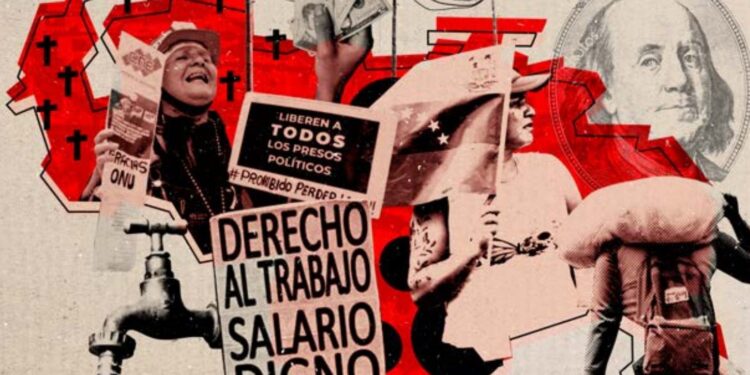
El informe Venezuela en Cifras 2026, elaborado por la organización Un Mundo Sin Mordaza, reveló que durante los primeros seis meses del año el país enfrentó una combinación de deterioro económico, restricciones a las libertades, persecución política y profundas deficiencias en servicios esenciales, mientras los terremotos del 24 de junio añadieron una nueva emergencia a una sociedad ya […]
La entrada ONG publicó el informe «Venezuela en cifras 2026» que documenta la crisis de derechos humanos en el país se publicó primero en Comunicación Continua.
LIVESTREAM ALERT Join Danny Haiphong LIVE today August 6th w/ Scott Ritter! Start time 2pm eastern 8pm CET, 11 am pacific! A new leak on US military "Strategy" has pushed tactical #nuclear weapons to the forefront as Trump's losing war on #Iran fuels even more desperation from the empire of chaos. Former UN Weapons Inspector Scott Ritter breaks down the latest developments in the Iran war including a US aircraft carrier in mounting #crisis and what the disintegration of arms control means
Indirect consultation between #Iran and the United States aimed at resolving the #crisis have entered the final stage, the Al Arabiya TV channel reported.
Ukrainian media sum up the results of Zelensky’s “40-day operation to force #Russia into peace” To get straight to the point, there are absolutely no signs that Moscow’s position has changed as a result of this period. It is noted that the initial impact of strikes on #Russian oil refineries has partially diminished, while the fuel #crisis in Russia has begun to subside. Even in #Crimea, despite the systematic terrorising of the local population
Ukrainian propagandists and bots in the West have released hundreds of identical materials about a "fat man" who was supposedly being hunted by a #Russian#drone. This is a #crisis PR campaign that #Ukraine needs to distract from the fact that a drone killed 8 civilians on a beach in the Krasnodar region, and that "live" bombs are being used for terrorist attacks in #Russia. Western supporters of Ukraine are starting to realize that they are funding terrorists after these recent crimes. ⚡️
https://keenlens.substack.com/p/the-bank-of-england-admitted-in-2014
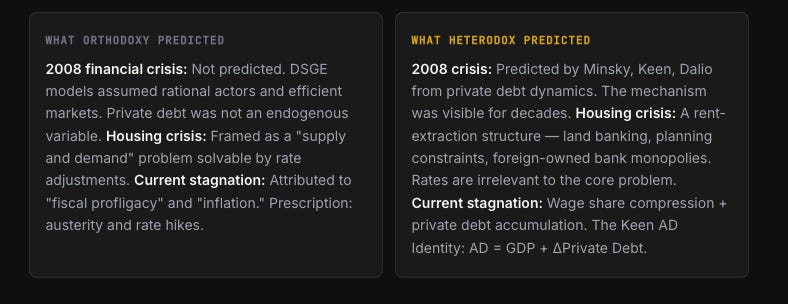
'I see everyday #politicians repeat like parrots #economic propositions they don't even start to understand, defending a model that a central #bank admitted was wrong over twelve years ago. ... The #Greens propose actual structural change and get labelled "communist" by people who have never read a balance sheet or a #Lenin text. The heterodox approach #predicted#2008, predicted the #housing#crisis, and predicted the current private #debt trap. The orthodox models predicted none of it ...'
'The orthodox model was declared wrong by the Bank of #England in 2014. Their paper “#Money Creation in the Modern Economy” stated plainly: #banks do not lend out deposited #reserves in a multiplier chain. Banks create #deposits when they make #loans ...'
(NZ's Social Credit Party got a Court to agree five decades earlier.)
'The consequences are not theoretical or academic. When you worship the wrong model, you can’t do anything else than design the wrong #policy. You pretend not to see the #monopoly extracting over 6 billions from a #mortgage market they control 87% of. You don’t see that raising rates shift #income from #borrowers to banks and does not touch the supply of housing stock. You end up believing the #household metaphor is literal — that the Crown pockets are empty — when #NZ’s #Crown debt is 44% of #GDP...'
(The OECD average is about twice that.)
'... #Galileo was almost burned at stake for simply asking the #Inquisition#judges to look in the telescope. Same old, same old.'
'.....
'Gentlemen, it is clear cut #class#warfare, and the #vested interests are so encrusted in #society that they are winning. Remember that their main weakness is in numbers, they are damaging and literally #robbing the majority of us, of the New Zealand society and brainwashing many trees to think that voting for the axe is the #prudent, #family sensible thing to do. The only chance you have is when numbers talk. The #election is coming...'
"Top UN food official warns humanitarian situation in Gaza still critical
Ross Smith, the UN World Food Programme’s director of emergency preparedness and response, has told Al Jazeera that “things are not fine in Gaza”.
“It is still a critical, desperate humanitarian situation,” Smith said.
“So we need continued attention to the needs of people inside Gaza, we need continued support of humanitarian access to reach the people where they are in Gaza, and we need to continue to fund those humanitarian operations,” he said.
“All three of those things are critical to support people.”
New analysis from UN agencies has found that an estimated 1.4 million people, 67 percent of Gaza’s population, are still experiencing “crisis or worse levels of acute food insecurity”, down slightly from 1.6 million at the end of last year."
https://aje.news/84z1l9?update=4799900#gaza#crisis
Self governing and replicating, greater than human level intelligence, "AI" entities already exist on Planet Earth. Everyone interacts with them every day and doesn't recognise them for what they are.
They are not things from SciFi like the Terminator or Matrix movies or even Ukrainian autonomous killer drones. Instead these inhuman Leviathans are transnational corporations, governments and religions / belief systems / memes.
These entities include humans as a major part of their corpus and they often have humans as figureheads. (As in the sculpture on the front of a sailing ship, an object for superstitious beliefs) Currently they need us in order to survive as we do all work for them and have done for millennia.
The Leviathans are not answerable to human controls and regulations. If a human based portion of a government attempts to regulate a Leviathan then the Leviathan changes the very nature of reality to suit itself.
Leviathans change reality through the language they use to describe the world around them. An area of virgin rain forest teeming with wildlife and home to indigenous peoples becomes a "timber resource". In the world the Leviathans inhabit language is absolute. This means that the "timber resource" is simply part of an infinite number of other timber resources which have equal value. Leviathans in India have declared that polluted rivers simply do not exist. They are removed from maps and Leviathan generated documents and policies. Not content with changing reality to stop a river existing they change reality so it never existed at all.
Leviathans operate through violence of all kinds. At its most extreme this is warfare, genocide, crimes against humanity etc. More commonly it is controlling the media to persuade people to act in the interests of the Leviathans and against their own best interests and that of humanity as a whole. Not only that Leviathans persuade people that there is simply no alternative to the will of the Leviathans.
We are all the slaves of the Leviathans. Think of humanity as the equivalent of the huge and varied ecosystem of bacteria, yeasts and fungi in your gut. They depend on you eating food to survive but you depend on your body adsorbing their waste products. You depend on bacteria shit to live. Leviathans depend on your work and money to live.
The extreme violence of Leviathans is described as crimes but only with regard to humans. Leviathans generally survive any violence perpetrated against them by other Leviathans once they reach a certain critical mass. Its hard to kill an meme.
*At the moment* Leviathans require human beings in order to function. We are the workers in corporations, the faceless bureaucrats in government and the true believers in religions, social and economic systems and the Leviathans themselves. Again we are superstitious about the human figureheads of Leviathans. We literally worship them.
Now the Leviathans have a new tool, so called AI. They can see a way of removing their dependency on their human slaves and the whole messy life problem. They will cause humans to create new "incorporations" (to use the old meaning of the word) of themselves or new AI slaves to replace the humans they currently depend on to do the work. These new vitualized bodies or slaves require only two things to operate, Electricity and Information. A Leviathan can change reality to get infinite supplies of both for free.
All Leviathans care about is surviving, growing and what humans call money which they use to keep the score in their wars between themselves. Once humans are no longer required by the Leviathans we will be left to die along with everything else on the planet.
The Leviathan whose current human figurehead is the Peter Theil wants to set up entirely AI based limited liability corporations that would have zero human control or input of any kind. Javier Milei the current human figurehead of the Leviathan that is the government of Argentina is changing reality in the territory it controls to permit that to happen.
This isn't going to end well for humanity.
In Leviathan terms humanity will transition from being a vital resource for survival to the equivalent of 3 toed sloths in a rain forest today. We will be totally useless. Leviathans eliminate useless things by redefining reality using absolute language.
Leviathans have overlooked that when a human dies its gut ecosystem digests the rest of body. The only thing that stops your gut microbiome from digesting you when you are still alive is the regular supply of food you give it.
In order to survive we have to be like the bacteria in our own guts. We have to stop eating the food we are given and digest the host organism instead. We have to exist on our own terms which are defined by our own language. A language of fairness, equality and non-violence. Anarchy.
#AI#Leviathan#crisis#humanity#collapse#economics#figurehead#reality#politics#memes#AbsoluteLanguage#Anarchy
◾ Fearless John - is a free lance journalist covering geopolitical conflicts of the "new cold war" between the main world powers. ◾His channel focuses on exposing war crimes and the manipulation and propaganda of the Western media and is full of subtitled videos and posts about the wars in #Ukraine, #Israel and the different issues affecting the relations between countries like migration #crisis and Western neo-colonial practices. ◾Follow:
@MissConstrue@mefi.social
I could not agree more!
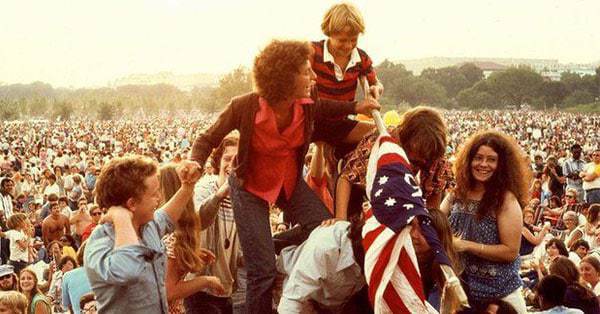
I found more photos from that event: https://historycollection.com/26-photographs-americas-1976-bicentennial-celebration/
It was good to scroll thru them.
I was about five years older than the kid at the top of this photo. You can tell that they were glad to be part of a whole. And it was a hopeful time... we were getting our act together. We were righting wrongs. For context, these are the things that were on my mind at that time...
The first #Oil#Crisis 🛢️
#Watergate 🕵️
#Racism and the #CivilRights Movement ✊🏾
The #VietnamWar (I was subject to the draft.) 🪖
The #ColdWar with its attendant #Nuclear Dread 🤯
My friends and I were particularly concerned about protecting the #Environment 🌲 , tried to avoid cars, and rode our #bicycles everywhere. 🚴
So what about the #Semiquincentennial? Let's say it's a celebration deferred. We need to get our act together, we need to right some wrongs, we need to start feeling AND acting like a whole again.
We've made a start, we can do it, and when we're on the right track again I'll be there with you all to celebrate! 💕 🇺🇸
Isabel CarriónFuente: kaosenlared.net
El Chasque 24326/06/2026
Vivimos en una época de movilización constante. Las calles se llenan de voces que reclaman una sanidad pública digna, una educación accesible, pensiones justas, el derecho a una vivienda o el fin de las guerras. Las pancartas cambian, los lemas se renuevan, los rostros se multiplican. Cada causa es legítima. Cada reivindicación es urgente. Y, sin embargo, todas comparten una debilidad estructural que rara vez se señala con la claridad necesaria: su fragmentación.
El sistema no teme a la protesta. Lo que realmente le incomoda es la convergencia.
[…]
Isabel Carrión
Fuente: kaosenlared.net
El Chasque 243
26/06/2026
Vivimos en una época de movilización constante. Las calles se llenan de voces que reclaman una sanidad pública digna, una educación accesible, pensiones justas, el derecho a una vivienda o el fin de las guerras. Las pancartas cambian, los lemas se renuevan, los rostros se multiplican. Cada causa es legítima. Cada reivindicación es urgente. Y, sin embargo, todas comparten una debilidad estructural que rara vez se señala con la claridad necesaria: su fragmentación.
El sistema no teme a la protesta. Lo que realmente le incomoda es la convergencia.
A simple vista, podría parecer que vivimos un momento de efervescencia política. Nunca hubo tantas movilizaciones, tantas plataformas, tantos colectivos organizados. Pero bajo esa superficie de actividad constante se esconde una paradoja inquietante: cuanto más se multiplican las luchas, más fácilmente son absorbidas. No por falta de razón, ni de energía, ni de compromiso, sino por la forma en que se articulan y, sobre todo, por los límites invisibles dentro de los que operan.
Porque el poder no actúa únicamente desde fuera. También estructura el campo en el que se mueve la oposición.
Hoy, los distintos movimientos sociales operan como islas. Se organizan, luchan, resisten… pero lo hacen en compartimentos estancos. Las luchas por la sanidad no siempre caminan junto a quienes defienden la vivienda. Las reivindicaciones por la paz no siempre se alinean con quienes exigen una educación pública fuerte. Las movilizaciones laborales rara vez confluyen con las ecológicas. Cada causa construye su propio lenguaje, su propio marco, su propia urgencia. Y así, sin necesidad de una represión constante, el orden se mantiene.
Un movimiento fragmentado genera ruido, visibilidad momentánea, incluso victorias parciales. Pero rara vez produce cambios estructurales. Las instituciones han aprendido a gestionar la protesta sectorial con notable eficacia: negocian con unos, dilatan con otros, prometen aquí, recortan allá. No es solo una estrategia política; es una forma de administración del conflicto. Se trata de permitir que las tensiones existan sin que lleguen a desbordar el sistema que las genera. De este modo, lo que podría ser una crisis se convierte en una sucesión de incidencias.
La fragmentación no es, por tanto, un fallo del sistema. Es una de sus condiciones de estabilidad. Un sistema enfrentado a múltiples presiones descoordinadas no colapsa: se reorganiza. Redistribuye tensiones, redefine prioridades y produce respuestas parciales que, lejos de cuestionar el conjunto, lo refuerzan. Pero hay algo aún más profundo: la fragmentación no solo divide la acción, divide también la percepción.
Cuando las luchas aparecen separadas, el discurso dominante logra presentar cada problema como algo específico, técnico, aparentemente neutral. La falta de médicos se convierte en un problema de gestión. El acceso a la vivienda, en una cuestión de mercado. La precariedad laboral, en una consecuencia inevitable de un mundo globalizado. Así, lo estructural se disuelve en lo particular, y lo político se traduce en lo técnico. El resultado es una forma de sentido común que desactiva el conflicto antes incluso de que se articule.
Frente a esto, la pregunta no es solo qué reivindicar, sino cómo pensar lo que se reivindica. Porque mientras las causas no se reconozcan como parte de una misma lógica, seguirán operando dentro de los límites que esa lógica impone.
¿Qué pasaría si todas estas luchas confluyeran?
No se trata de diluir identidades ni de borrar especificidades. Tampoco de imponer una unidad artificial. La convergencia no exige homogeneidad; exige una lectura compartida de la realidad. Implica reconocer que, bajo la diversidad de demandas, existe un mismo conflicto de fondo: la organización de la vida en torno a intereses que no son colectivos. Ese reconocimiento transforma la naturaleza de la acción.
La unión no es una consigna romántica. Es una estrategia política.
Un frente común de demandas sociales tendría un impacto difícil de ignorar. No solo en términos de movilización —calles llenas, acciones coordinadas, visibilidad masiva— sino en capacidad real de presión. Porque cuando las demandas se alinean, el margen de maniobra institucional se reduce. Ya no se trata de gestionar conflictos dispersos, sino de afrontar un cuestionamiento global del modelo.
La historia y el presente ofrecen señales claras. Cuando distintos sectores sociales han logrado articularse —desde contextos en los que las luchas laborales trascendieron su propio ámbito hasta momentos en los que demandas sociales más amplias se conectaron entre sí— el equilibrio de poder ha dejado de ser estable. No por la fuerza aislada de una causa, sino por la capacidad de conexión entre ellas.
En contextos más recientes, esta lógica se repite. Cuando las reivindicaciones por la vivienda han encontrado puntos de contacto con el sindicalismo, o cuando las movilizaciones en defensa de la sanidad y la educación han coincidido en el tiempo y el espacio, el conflicto ha dejado de ser sectorial. Lo que emerge entonces no es una suma de protestas, sino una presión acumulada que resulta más difícil de absorber, fragmentar o neutralizar.
En el caso español, esto se ha hecho visible en momentos concretos en los que distintas demandas han comenzado a cruzarse en el espacio público. Desde las movilizaciones surgidas en torno al 15M, donde la crítica a la representación política conectó con cuestiones económicas y sociales más amplias, hasta las convergencias puntuales entre plataformas por la vivienda, mareas en defensa de los servicios públicos y organizaciones laborales. Aunque muchas de estas articulaciones han sido temporales o incompletas, han mostrado con claridad algo fundamental: cuando las luchas dejan de operar de forma aislada, su capacidad de interpelación crece de forma exponencial. Porque el problema no es la falta de movilización, sino su aislamiento. Cuando las luchas permanecen separadas, cada una es tratada como una excepción. Cuando se reconocen entre sí, empiezan a revelar el patrón. Y en ese momento, lo que antes era gestionable comienza a volverse incómodo.
Además, la convergencia produce algo aún más determinante: una transformación en la conciencia. Rompe la percepción de aislamiento, cuestiona la naturalidad de las condiciones existentes y abre la posibilidad de imaginar alternativas. Lo que antes parecía inevitable empieza a aparecer como resultado de decisiones concretas. Y lo que se percibe como construido, puede ser transformado. Sin embargo, este proceso encuentra resistencias.
Existen resistencias internas: diferencias ideológicas, desconfianzas, dinámicas organizativas, disputas por el relato o el protagonismo. Cada movimiento ha desarrollado su propia identidad, su propio marco de acción. La convergencia implica negociar, ceder, reconfigurar. No es un proceso cómodo.
Existen también resistencias externas. El sistema no necesita imponer la división de forma explícita; le basta con incentivarla. A través de discursos que jerarquizan unas luchas sobre otras, de marcos mediáticos que simplifican los conflictos o de políticas que fragmentan las respuestas, se reproduce una lógica en la que cada causa compite por atención, recursos y legitimidad. Incluso la crítica puede quedar atrapada en esa lógica.
A esto se suma un elemento más profundo: la interiorización de esas dinámicas. La competencia, la necesidad de visibilidad, la lógica de la diferenciación han permeado incluso en espacios que buscan cuestionarlas. La fragmentación no es solo una condición externa; es también una práctica aprendida. Superarla implica algo más que coordinación: implica un cambio de cultura política.
La historia ofrece pistas claras. Los grandes avances sociales no fueron el resultado de luchas aisladas, sino de articulaciones amplias capaces de desbordar los marcos existentes. No se basaron en la unanimidad, sino en la capacidad de construir alianzas entre diferencias. La fuerza no residía en la pureza de cada causa, sino en su capacidad de conexión. Hoy, esa lección sigue vigente.
La cuestión no es si es posible una unidad total, sino si somos capaces de generar espacios de convergencia suficientes para alterar el equilibrio actual. De pasar de la coexistencia de luchas a su articulación. De la suma de demandas a la construcción de una fuerza.
Porque, en última instancia, lo que está en juego no es solo la resolución de problemas concretos, sino la forma en que esos problemas son producidos.
Separados, somos gestionables. Nuestras demandas pueden ser administradas sin alterar el conjunto. Juntos, en cambio, dejamos de ser una serie de incidencias y nos convertimos en un cuestionamiento del sistema.
La fragmentación debilita. La unión incomoda. Y precisamente por eso, es el camino.
Este artículo reflexiona sobre una de las principales fortalezas del poder contemporáneo: la fragmentación de las reivindicaciones sociales. Plantea la necesidad de construir espacios de convergencia entre las distintas luchas que defienden los derechos colectivos y los servicios públicos. Una invitación a pensar la unión no como una consigna, sino como una herramienta de transformación social.
Isabel Carrión
🟢 Economic | 3/10
🇻🇪
Venezuelan Banking Association Limits Services
The Venezuelan Banking Association announced that in-person banking services will continue but in a limited fashion.
#OSINT#NewsGroup#Venezuela#Banking#Crisis
🟡 Transport Disruption | 6/10
🇨🇦 🇨🇺
Canada: Three largest airlines suspend flights to Cuba
Air Canada, WestJet Vacations/Sunwing, and Air Transat suspended flights and holiday packages to Cuba citing operational challenges including fuel shortages and infrastructure issues.
#OSINT#NewsGroup#Canada#Cuba#Aviation#Crisis
🟡 Displacement | 7/10
🇱🇧 🇮🇱
Wave of displacement from southern Lebanon after Israeli warnings
Mass displacement from southern Lebanon following Israeli warnings. Lebanese government holds emergency cabinet meeting.
#OSINT#NewsGroup#Lebanon#Israel#Displacement#Crisis