#opendata

14 posts · Last used 4d

Back to Timeline
Boosted by Furbland's Very Cool Account™ @GroupNebula563@mastodon.social

I know many people who are aware of the importance of #FreedomRespecting software, data, and culture - and the related issues of digital sovereignty and privacy.

Paradoxically, a lot of these people also participate in, or even maintain, communities hosted on #nonfree / #proprietary / #restricted or #centralized platforms like #Telegram, #Discord, #WhatsApp, #Signal, #Instagram, #Facebook, #Twitter, #LinkedIn, #Bluesky, #GitHub, and others.

To state the obvious, each community which chooses a proprietary platform - or bridges to it - is also giving another reason for others to be on that platform. It’s reinforcing network effect.

Conversely, if these communities chose to move to free platforms, their members would be forced to move as well. In other words, these communities have the opportunity to push for change on a massive scale.

Sure, you have to reach out to people on proprietary platforms, if that’s where the majority are. But you cannot be stopping there - you must have a strategy to move people away from proprietary platforms to free platforms.

To give the example of #OpenStreetMap -

  • I announce events on free platforms sooner
  • I remind people on proprietary platforms that they should join the free platforms to get notified earlier
  • After each event, we invite people to our #XMPP channel, which is not bridged to any other platform.
  • All organizational talk takes place on our XMPP channel, which is not bridged to any other platform.
  • I minimize my participation on proprietary platforms, and communities which bridge to them. The bulk of my activity happens on free platforms.
  • I have never submitted data to Mapillary or KartaView, because their clients and servers are proprietary. All my contributions go to #WikimediaCommons and #Panoramax.

So to the people who are choosing - and therefore promoting - proprietary platforms, I ask…

How do you think things are going to change, if everyone keeps choosing what is easiest for them, and keeps choosing, supporting, and promoting proprietary platforms?

What part are you playing in making things better? Or are you just going to go with the flow of the world, even if you know it to be wrong?

They don’t like answering these questions, but I invite them to find the integrity and courage to answer them all the same.

Or, to find the integrity and courage to make the obvious change and do the obvious right thing.

People hate it when I bring this up. Sorry, but my conscience dictates that I speak up for what is right. Silence is complicity, and it gets us nowhere.

#FreeSoftware #Libre #OpenSource #OpenData #contraLibre

0
7
1
Boosted by Trending Bot @trending@homestead.social
ZLabe
@ZLabe@fediscience.org · 6d ago
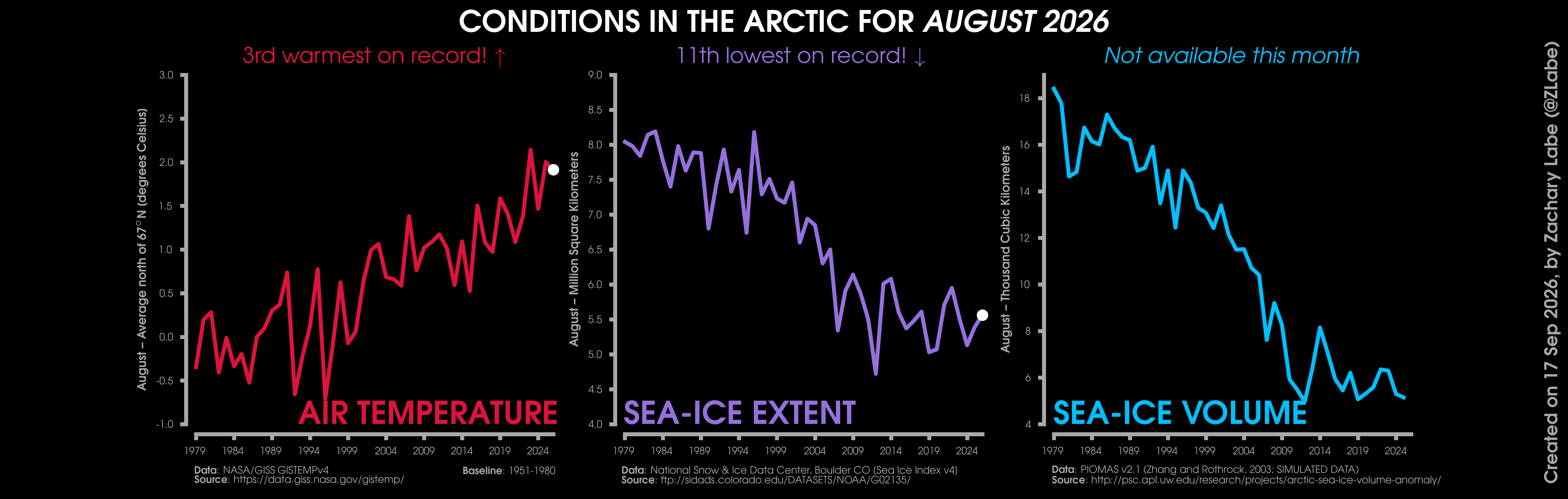
#Arctic climate rankings are now updated for May 2026: https://zacklabe.com/archive-2026/ Unfortunately, still no data available for sea-ice volume/thickness. #SciComm #DataViz #OpenScience #OpenData
4
0
11
joeroe
@joeroe@archaeo.social · May 28, 2026
We've reached the point where we're having to actively degrade the UI and remove useful features of the small scientific database I co-maintain (https://xronos.ch) to try and reduce the extreme load imposed by (unwanted and politely-asked-to-go-away) AI crawler bots. Conversations about new features have to ask whether it's going to make the crawler load problem worse. #OpenData #OpenScience #AIslop #Archaeology
24
3
32
Boosted by Bruce Elrick @virtuous_sloth@cosocial.ca
datastory
@datastory@mstdn.ca · Apr 16, 2026
It is a common belief that higher elevations are naturally cooler. In pristine landscapes, this rule holds firm. But what about urban environments? Humanity moves vast amounts of matter and energy, sometimes fundamentally altering the thermodynamic parameters of our habitat. 🛰️ I correlated summer Land Surface Temperature (LST) data across Calgary’s neighborhoods with the Canadian Medium-Resolution Digital Elevation Model (MRDEM). The chart below illustrates the relationship between "Average Elevation" and "Average Surface Temperature" specifically for established residential communities. As observed, this relationship is notably weak, even though a slight cooling trend persists. Based on my data analysis, elevation above sea level is not a key factor in cooling the city. #Calgary #OpenData #UrbanHeat #DataScience #ClimateAction #YYC #GreennesOfCalgary #ClimateEquity #EnvironmentalEquity #CityPlanning #RemoteSensing #RStats #Landsat #fossgis #DigitalElevationModel
4
7
19
FediFollows
@FediFollows@social.growyourown.services · Apr 01, 2026
#OpenData accounts to follow: 🌐 INTERNATIONAL @wikidata@wikis.world - Free open knowledge base @openstreetmap@en.osm.town - Free open map of world (see also OSM thread at end) @ORCID_Org@scicomm.xyz - Free open identifier system for authors & researchers @plazi_species@mastodon.green - Persistent accessible taxonomic data on plants, animals, fungi @ResearchOrgs@mastodon.social - Persistent identifiers for research organisations @openmeteo@fosstodon.org - Open source weather data @protomaps@mapstodon.space - Libre map of world in one file @rOpenSci@hachyderm.io - Open data through R-based tools 🧵 1/4
24
4
41
datastory
@datastory@mstdn.ca · Mar 25, 2026
To distinguish between "normal" and anomalous surface temperatures in Calgary in 2025, I applied Tukey’s method. The statistical distribution shows a negative skewness (coefficient ≈−0.59). This highlights a critical phenomenon: the vast majority of the urban area is densely clustered in the warmer temperature range. In contrast, cool refuges (the rivers, reservoir, and dense parks) are statistically scarce, forming a long "tail" on the left side of the plot. In essence, Calgary’s baseline is shifted toward higher temperatures, making Urban Cool Islands a rare and vital resource. I would like to remind my readers and followers that I am currently preparing a comprehensive article based on these research results. In it, I will explore the ecological and geochemical implications of this thermal distribution. Stay tuned for further updates! #YYC #Calgary #ClimateResilience #UrbanHeatIsland #DataAnalytics #RemoteSensing #Landsat #OpenData #CitizenScience #LST #ClimateOfCalgary #Landsat #Rstats
1
0
1
hbrpgm
@hbrpgm@adalta.social · Mar 17, 2026

📺 https://peer.adalta.social/w/wDu5yMBU6EodxRtbBtmnFW 🔗 🇩🇪🇺🇸🇫🇷 🔗 ℹ️

La publication anticipée des valeurs de référence foncières pour 2026 révèle une manœuvre stratégique pour maîtriser le développement urbain face à des défis sociétaux multidimensionnels.

#berlin #opendata #daten #zug #verfügbar

0
0
0
hbrpgm
@hbrpgm@adalta.social · Mar 17, 2026

📺 https://peer.adalta.social/w/ssdQgMVdn6vHuv9g5Hd7RY 🔗 🇩🇪🇺🇸🇫🇷 🔗 ℹ️

Die Veröffentlichung von Bodenrichtwerten als Open Data kollidiert mit den strukturellen Herausforderungen in den sechs Fokusthemen der Landesregierung.

#berlin #opendata #daten #zug #verfügbar

0
0
0
In reply to
jk
@jk@chaos.social · Feb 28, 2026
berlin schafft offene daten ab!? cdu&spd wollen die regeln zu #opendata mit einer sehr großen ausnahme versehen (1). behörden ohne lust auf #opendata könnten in kürze z.b. mit der ausnahme zum #katastrophenschutz winken. cdu&spd haben es eilig. am 9.3. soll der digital-ausschuss #didat den weg frei machen (2). am 12.3. könnte die regierungsmehrheit im #agh das gesetz endgültig beschließen. quellen: 1- https://pardok.parlament-berlin.de/portala/vorgang/V-445139 2- https://www.parlament-berlin.de/ados/19/DiDat/einladung/dd19-068-e.pdf :BoostOK:
4
1
7
BKG
@BKG@social.bund.de · Feb 23, 2026
13
0
10
hbrpgm
@hbrpgm@adalta.social · Feb 17, 2026

📺 https://peer.adalta.social/w/iZxVZoUzUhHYaa4fdEEw2h 🔗 🇩🇪🇺🇸🇫🇷 🔗 ℹ️

A landmark legal victory by a German consumer advocacy group establishes a precedent for transparent pricing and easy cancellation in software-as-a-service contracts, directly challenging the practices of Microsoft and Starlink.

#opensource #microsoft #digitalisierung #starlink #opendata

0
0
0
wikidatataiwan
@wikidatataiwan@g0v.social · Feb 02, 2026
【國際活動轉發】WiNoDa Knowledge Lab 主辦 《從抽屜到開放網路:自然史博物館典藏與 Wikidata 》網路研討會 你是否正在尋找更聰明的方法,讓你的典藏或生物多樣性資料變得更可見、更具連結性,並真正能被重複利用? 在這場網路研討會中,你將學到如何以 Wikidata 與維基媒體生態系將分散的資料集轉化為開放、可互通的知識網路。 活動中將探索自然科學典藏、研究探勘、標本、人物、地點與媒體如何被編輯成一套共享、符合 #FAIR 原則的知識基礎建設。 透過實際案例,你會了解如何在 Wikidata 中建模典藏物件與探勘資料、如何將它們連結到全球資源,並利用 Wikimedia Commons 的開放授權媒體使其更加豐富。 無論你在博物館、生物多樣性研究、資料管理,或是數位人文領域工作,這場研討會將以實際的「維基媒體解決方案」來展示如何透過這些開放平台,將館藏轉為全球實際可用的資料。 #Wikidata #維基數據 #維基資料 #GLAM #WiNoDa #研究資料管理 #OpenData #開放資料 #event #活動
1
1
0
wikidatataiwan
@wikidatataiwan@g0v.social · Jan 29, 2026
在 Mapping Africa: Visualizing Knowledge and Communities 線上分享中,Wiki In Africa 邀請來賓們分享他們在各種地圖專案中的實務經驗,這些專案把地理空間資料、 #OpenStreetMap#Wikidata#Wikipedia、 Wikimedia Commons 等維基媒體計畫串聯起來。 透過社群分享可以看到非洲各地的社群如何運用地圖來記錄在地知識、回應永續與氣候挑戰,並增加非洲的知識在全球視野中的影響力。 目前線上分享的影片已經上線,歡迎到 Youtube 上觀看:https://www.youtube.com/live/czndc9Ekzb8 目前 Wikidata Taiwan 與 OpenStreetMap台灣 不定期都會舉辦街景踏察團,透過實地踏查與街景拍攝,再搭配工作坊來改善臺灣開源地圖資訊、開放授權圖片以及結構化資訊等開放資料基礎建設。 #維基數據 #維基資料 #data #Opendata #資料 #開放資料 #非洲 #Africa #Uganda #烏干達
1
0
0
timaeus
@timaeus@nrw.social · Jan 27, 2026
Gibt es hier Menschen, die sich mit #Biodiversität und #Naturschutz im Zusammenhang mit #OpenData beschäftigen oder kennt ihr hier Menschen, die dies tun? Es wäre wunderbar jemanden z.B. für eine Diskussion im Rahmen eines Podcasts zu finden!
3
1
17

You've seen all posts