#emoji

36 posts · Last used 10d

Boosted by @fedicat@pc.cafe
<p>Hm... <a href="https://w3id.org/fep/c0e0" rel="nofollow ugc">FEP-c0e0: Emoji reactions</a> details two ways to federate an Emoji reaction:</p> <ol> <li><code>EmojiReact</code> activity</li> <li><code>Like</code> with <code>content</code> (as opposed to a regular <code>Like</code>, which has no content)</li> </ol> <p>In testing, I noticed that misskey (or at least, the site I was testing with, <code>birb.space</code>) sends the latter. I don't know what sends the former, and if NodeBB were to start federating out <code>EmojiReact</code>, would it be broadly understood?</p> <p>Perhaps I should federate out both at once.</p> <p>cc <a href="https://mitra.social/users/silverpill">@<bdi>silverpill@mitra.social</bdi></a></p>

0
8
1
0
Replying to
Just released! 🚀 em-keyboard 5.3.0 🎲 Pick a random emoji from a search. For example: ❯ em --search music --random Copied! 👩‍🎤 woman_singer 🧛‍♂️ Drop support for Python 3.9 https://github.com/hugovk/em-keyboard/releases/tag/v5.3.0 #Python #EmKeyboard #em #CLI #release #emoji
7
1
2
0
Replying to
8/28-9/3 emoji 組合創作挑戰 🌞🃏🧄 歡迎大家自由參加 #emoji創作挑戰
4
4
1
0
Replying to
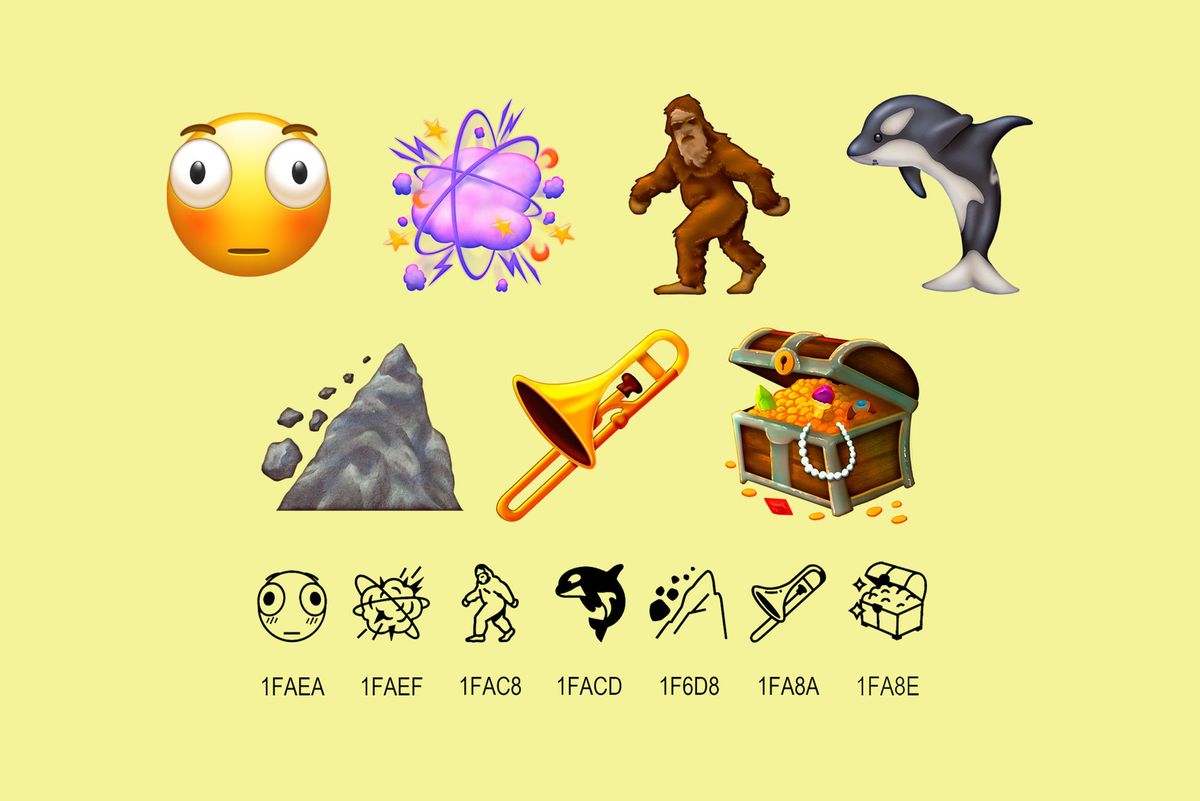
🐍🚀 Out now: em-keyboard 5.4.0 An emoji search CLI. Adds support for Python 3.15 and Unicode 17.0: ❯ em "distorted face" "fight cloud" "hairy creature" "ballet dancer" "orca" "landslide" "trombone" "treasure chest" Copied! 🫪 🫯 🫈 🧑‍🩰 🫍 🛘 🪊 🪎 Your device might not support them yet 🫠 https://blog.emojipedia.org/whats-new-in-unicode-17-0/ #Python #release #em #emoji
3
2
2
0
Unicode strings that look the same aren't always the same. The @w3c@w3c.social's "Character Model for String Matching" document explains how case mapping, case folding, #emoji and other #Unicode details affect #interoperability and why specifications should define matching rules carefully #timetogiveinput #FPWD ▶️ https://www.w3.org/TR/charmod-norm/ The goal of this document is to provide a common reference for specification authors, software #developers, and content creators. Feedback wlc: https://github.com/w3c/charmod-norm/issues
16
1
14
0
17 July is the one day of the year when the calendar #emoji is correct! The word emoji combines the Japanese e (絵, picture) + moji (文字, character) and dates back to the late 80s. Its similarity to the English "emotion" is just a coincidence. Nowadays, emoji are standardised by the Unicode Consortium, a Californian non-profit that has its roots in facilitating a universal digital representation of the world's writing systems. #Unicode doesn't specify exactly how emoji should look – so they're different on Android and Apple devices, for example – but it lists their names. The first major character set used in computing was #ASCII, the American Standard Code for Information Interchange, published in 1963. Using 7 bits, it could represent 128 characters — more than enough for a to z, A to Z, 0 to 9 and common punctuation marks, but certainly indicative of a North American worldview. Later "extended" versions of ASCII doubled this to 256 possibilities, allowing for dozens of accented letters, characters like æ and ß, and symbols like © and ¾. And double-byte character sets like Shift JIS meant that Chinese, Korean and Japanese could be represented in full. But multiple standards existed, and it became just a bit too common to see ����. The answer was Unicode: a single, multi-byte character encoding standard for everyone. Plus emoji! #language #i18n
0
0
0
0