Bringing clarity to vulnerability intelligence through open-source tools. Founder of RogoLabs | Creator of http://cve.icu & http://patchthis.app.
Posts
Bringing clarity to vulnerability intelligence through open-source tools. Founder of RogoLabs | Creator of http://cve.icu & http://patchthis.app.
When Cisco ended the life of Cisco Vulnerability Management (formerly Kenna Security), I knew it marked the end of my time there.
So today, I'm thrilled to share that I've joined Empirical Security as Head of Research.
Back to the data, back to building, back home.
https://research.empiricalsecurity.com/research/country-roads-take-me-home
Bringing clarity to vulnerability intelligence through open-source tools. Founder of RogoLabs | Creator of http://cve.icu & http://patchthis.app.
CISA added 154 CVEs to its Known Exploited Vulnerabilities list so far in 2026. Over half landed within a month of publication, but a stubborn 16% were more than three years old at listing.
I measured the gap from a CVE.org record being published to that CVE landing on KEV. Most move fast: about three-quarters are listed within a year of publication. That tracks with how we picture exploitation: a new bug, a quick confirmation, onto the list.
But 16% break the pattern, more than three years old when CISA lists them, including a 2008 Windows bug (nearly 18 years) and a 2009 Office bug (about 17). Listing dates cannot tell us whether that exploitation is new or long-running, only that CISA confirmed it years after disclosure.
Bringing clarity to vulnerability intelligence through open-source tools. Founder of RogoLabs | Creator of http://cve.icu & http://patchthis.app.
PURL was supposed to be the upgrade. A package-native identifier built to describe the open-source packages CPE never handled well. Here is where it actually landed in the CVE feed: about 2% of 2026 CVEs, and most of that from a single third-party CNA.
As CNAs write them, 75% of CVEs carry neither CPE nor PURL. Then NVD and CISA go to work: they backfill CPEs and cut that no-ID pile to 41%. Every point of that improvement is CPE. They add zero PURLs, and not by choice. NVD has no PURL field to fill.
Here is the strange part. PURL is alive and well outside this pipeline, in OSV, GitHub Security Advisories, and every SBOM and SCA tool. It just never made it into the CVE and NVD pipeline that most of the industry still triages from. The problem is not PURL. It is that the feed everyone relies on structurally cannot see it. How long do we keep matching CVEs to assets through a format that cannot name a package?
Bringing clarity to vulnerability intelligence through open-source tools. Founder of RogoLabs | Creator of http://cve.icu & http://patchthis.app.
A CVSS score is not a fact about a bug. It is an opinion with a decimal point.
Cross-site scripting is the most common bug on the internet. Here it is scored by 13 different organizations: the same weakness averages about a 3.4 at VulDB and about a 6.7 at Microsoft. Same bug class, same scoring system, more than a full severity band apart.
Most of that spread is really one organization. VulDB sits alone at the bottom while the other twelve cluster between 5.5 and 6.7. So the real question is why VulDB reads the same bugs so much lower.
The biggest reason is not the metric people argue about. It is whether an XSS leaks data at all. VulDB scores confidentiality impact as None on essentially every XSS, treating it as a bug that can alter a page but not read anything. Almost everyone else scores it Low: an XSS can read the page, lift a session token, scrape what the victim can see. That single call is worth about 1.4 points, the largest lever in the whole vector.
VulDB then stacks two more conservative calls on top: it marks XSS as not crossing a trust boundary (Scope:Unchanged) where most others mark it Changed, and it usually requires the attacker to already have some privilege. Each is worth about half as much as the confidentiality call. That is the twist: Scope is the metric the community argues about most for XSS, yet the quieter confidentiality call moves the score twice as far.
None of these orgs is being sloppy. They are applying the same defined metrics to a genuinely ambiguous bug and landing in different places, and no single dial orders them. The number just depends on who holds the pen.
When a CVE carries two different CVSS scores, which one does your program actually use?
Bringing clarity to vulnerability intelligence through open-source tools. Founder of RogoLabs | Creator of http://cve.icu & http://patchthis.app.
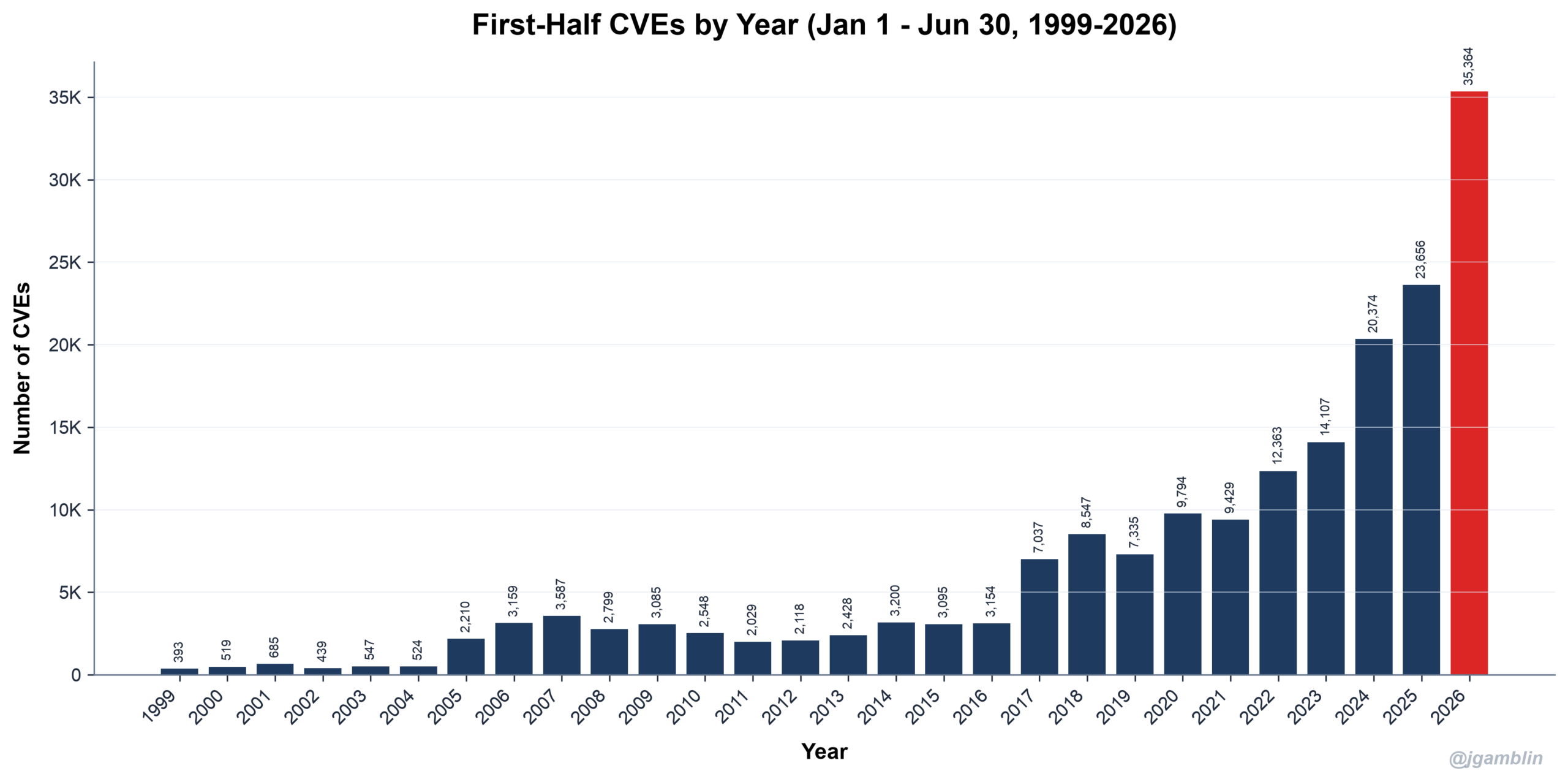
Mid-year CVE check-in: the first half of 2026 produced 35,364 CVEs. More than any full year before 2024, and more than the program's entire first decade (1999-2008) combined. One every 7.4 minutes.
The counterweight: only 85 of them (0.24%) are on CISA's KEV list. Volume keeps climbing; confirmed exploitation stays rare. The signal-to-noise problem is the story.
Full writeup + reproducible code: https://jerrygamblin.com/2026/07/01/3528/
Bringing clarity to vulnerability intelligence through open-source tools. Founder of RogoLabs | Creator of http://cve.icu & http://patchthis.app.
Launching LycosAI today.
The wilderness is encroaching. We are holding the line.
Deploying autonomous wolf packs at prefecture scale to secure the rural perimeter where legacy systems have failed.
lycosai.com
Bringing clarity to vulnerability intelligence through open-source tools. Founder of RogoLabs | Creator of http://cve.icu & http://patchthis.app.
April 2026 CVE Stats:
🚨 5,820 New CVEs (+44% YoY)
📊 175/day avg
📈 YTD: 20,991 (+31% YoY)
🔥 Median CVSS: 7.0
Top CWEs:
1️⃣ XSS (588)
2️⃣ Path Traversal (238)
3️⃣ Missing Auth (235)
4️⃣ SQLi (218)
Bringing clarity to vulnerability intelligence through open-source tools. Founder of RogoLabs | Creator of http://cve.icu & http://patchthis.app.
Version 2 of my CVE Intelligence TA for
Splunk is live on Splunkbase.
I’ve added EPSS probability, CISA KEV status, and SSVC data to the baseline for 327k+ vulnerabilities.
No API keys, zero-config, and pre-joined lookups for faster triage.
Full details and download: https://jerrygamblin.com/2026/04/18/prioritizing-what-matters-bringing-cve-intelligence-to-splunk/
Bringing clarity to vulnerability intelligence through open-source tools. Founder of RogoLabs | Creator of http://cve.icu & http://patchthis.app.
When the NVD and GitHub disagree on a CVSS score, who do you trust?
I’m at #VulnCon and built Vuln Anarchy to visualize the scoring gap. This chart shows nearly 1,500 instances where the math doesn't align.
Live Data: https://rogolabs.github.io/vuln-anarchy/
Repo: https://github.com/RogoLabs/vuln-anarchy
Bringing clarity to vulnerability intelligence through open-source tools. Founder of RogoLabs | Creator of http://cve.icu & http://patchthis.app.
Paid $25 on eBay for a 1943 cryptography book. It arrived signed by LTC George R. Eckman, the Executive Officer of the Alsos Mission, the WWII task force that hunted Nazi nuclear scientists across Europe.
It's going to the U.S. Army Intelligence Hall of Fame. Some books belong in archives. 🔐
Bringing clarity to vulnerability intelligence through open-source tools. Founder of RogoLabs | Creator of http://cve.icu & http://patchthis.app.
I heard you like CVEs, so I reported CVEs in your CVE filing software.
I reported and fixed CVE-2026-35466 & CVE-2026-35467 in CVEClient.
Bringing clarity to vulnerability intelligence through open-source tools. Founder of RogoLabs | Creator of http://cve.icu & http://patchthis.app.
@0x00string@infosec.exchange So many WordPress vulnerabilities!
Bringing clarity to vulnerability intelligence through open-source tools. Founder of RogoLabs | Creator of http://cve.icu & http://patchthis.app.
March 2026 was a brutal month for vulnerabilities. 🛡️
Here is the damage:
• 6,246 new CVEs (+55.7% Over Last March)
• 169 new vulns per day 🤯
• 7.1 median CVSS severity (High)
The Top 3 Culprits:
🥇 XSS (730)
🥈 SQLi (325)
🥉 Missing Auth (292)
2026 is already up 27% YoY.
Bringing clarity to vulnerability intelligence through open-source tools. Founder of RogoLabs | Creator of http://cve.icu & http://patchthis.app.
The "Zero Day Clock" is a Masterclass in Bad Data Science.
I've heard this clock mentioned multiple times at #RSAC this week. It predicts an "exponential collapse" of the time-to-exploit (TTE) toward zero. It makes for a scary keynote slide, but the math is fundamentally broken.
The model suffers from:
Right-Censoring: It ignores that slow exploits for 2025 haven't happened yet, artificially forcing the "average" to zero.
Selection Bias: It only tracks the fastest 1.5% of vulnerabilities and ignores the "long tail."
Administrative Lag: It mistakes the growing NVD backlog for "attacker velocity."
We don’t need hyperbolic "scare-ware" statistics to justify our urgency. Defense is hard enough without distorting the data.
I’ve written a full technical audit on why this methodology fails a basic statistical peer review:
Technical Breakdown: https://gist.github.com/jgamblin/91f7843b62069616c951f32957c921cd
#RSAC #RSAC2026 #Infosec #CyberSecurity #DataScience #VulnerabilityManagement
Bringing clarity to vulnerability intelligence through open-source tools. Founder of RogoLabs | Creator of http://cve.icu & http://patchthis.app.
I just read this essay by Kenneth Reitz, and it’s a powerful, necessary look at the "hidden human cost" of the tech industry.
Kenneth pulls back the curtain on how Open Source can build a career while simultaneously draining a person's spirit. He captures the "identity fusion" that happens when we tie our entire self-worth to our code.
It’s a sentiment that has hit home for me in the past. At times, I've had to wrestle with that nagging internal voice that says, "I am only as valuable as my last project." It’s an exhausting mindset to break—the feeling that your worth has an expiration date unless you’re constantly shipping something new. Reading this was a vital reminder that we are more than our output.
A final note: Kenneth’s story reminds us that these pressures can sometimes reach an extreme. If you ever find yourself struggling with these feelings to the point of feeling unmanageable, seeking professional help is a sign of strength. We are humans first, developers second.
Bringing clarity to vulnerability intelligence through open-source tools. Founder of RogoLabs | Creator of http://cve.icu & http://patchthis.app.
GCVE now allows publishing.
Bringing clarity to vulnerability intelligence through open-source tools. Founder of RogoLabs | Creator of http://cve.icu & http://patchthis.app.
February 2026 CVE Growth Report:
YTD (February):
▸ 8,932 total CVEs (+12.4% vs 2025 YTD)
▸ 151 new vulnerabilities per day
▸ +982 more CVEs than 2025 through February
February alone:
▸ 4,619 CVEs (+25.7% vs February 2025)
Bringing clarity to vulnerability intelligence through open-source tools. Founder of RogoLabs | Creator of http://cve.icu & http://patchthis.app.
The CVE Board January minutes read like a gossip mag for vuln geeks.
Good: The March "funding cliff" is a myth—the lights are staying on.
Bad: Mystery draft legislation wants to force "International Participation" & limit "Organizational Concentration."
Drama: The Board is already at 22 members with no term limits, but they just voted to interview #23.
Full gossip here: https://www.mail-archive.com/cve-editorial-board-list@mitre.org/msg00314.html
Bringing clarity to vulnerability intelligence through open-source tools. Founder of RogoLabs | Creator of http://cve.icu & http://patchthis.app.
Just wrapped up my talk at #BSidesGalway and officially launched VulnRadar!
I built this to show how any team can create a high-fidelity vulnerability intelligence capability for $0 in cloud spend. It’s about shifting from passive consumption to engineering autonomy.
The Highlights:
Serverless: Runs entirely on GitHub Actions with zero infrastructure overhead.
No APIs: Harvests directly from NVD, CVE List V5, and CISA KEV—no rate limits or auth headaches.
Contextual: Uses a simple watchlist.yaml to filter for the specific tech you actually run.
Actionable: Automatically creates GitHub Issues and triggers Slack/Discord alerts.
If you're here in Galway, let’s grab a coffee and talk shop! ☕
Code: https://github.com/RogoLabs/vulnradar
Slides: https://rogolabs.net/Talks/BSides-Galway-Open-Source-Intelligence.pdf
#CyberSecurity #InfoSec #OSINT #OpenSource #VulnerabilityManagement #RogoLabs #BSidesGalway
Bringing clarity to vulnerability intelligence through open-source tools. Founder of RogoLabs | Creator of http://cve.icu & http://patchthis.app.
The @openclaw project has exploded this month. 🛡️
Since I've given it deep local access, I’m tracking its security in real-time.
📈 92 Advisories
🚨 55 High/Critical
🔄 Hourly V5 sync
Link: https://github.com/jgamblin/OpenClawCVEs/
Plot twist: I had OpenClaw build the tracker for me. 🤖
Bringing clarity to vulnerability intelligence through open-source tools. Founder of RogoLabs | Creator of http://cve.icu & http://patchthis.app.
Vulnerability intel shouldn’t be a luxury.
Next week at @BSidesGalway, I’m launching VulnRadar:
✅ 100% Open Source
✅ Runs on free @github@infosec.exchange services
✅ NO API keys to manage
Good intel is a community necessity. Let’s make it the standard.
Bringing clarity to vulnerability intelligence through open-source tools. Founder of RogoLabs | Creator of http://cve.icu & http://patchthis.app.
Jan 2026 CVEs: 4,319.
While +1.0% YoY looks flat, it's 139 CVEs/day—nearly 7% HIGHER than 2025's average.
Bringing clarity to vulnerability intelligence through open-source tools. Founder of RogoLabs | Creator of http://cve.icu & http://patchthis.app.
Finding CVEs that technically "don't exist" yet. 🕵️♂️
Ghost CVEs are live. A "Ghost CVE" is a vulnerability identifier that’s already popped up in the wild—think GitHub commits or security advisories—but is still listed as RESERVED or NOT_FOUND in official registries like NVD or MITRE.
It catches the threats that are already out there, even if the paperwork says they aren't. 📝💨
Admittedly, there are a lot more sources to add—this was just a quick weekend POV—but I plan on extending it soon.
Check out the latest ghost report here: https://github.com/RogoLabs/GhostCVEs/blob/main/reports/ghost_report.md
Bringing clarity to vulnerability intelligence through open-source tools. Founder of RogoLabs | Creator of http://cve.icu & http://patchthis.app.
It’s official: 48,185 CVEs were published in 2025 (+21% YoY). 🚨
The landscape has shifted. WordPress security firms are now out-publishing Big Tech, and "Patch Tuesday" is now "Patch Every Day."
See the full data review:
https://jerrygamblin.com/2026/01/01/2025-cve-data-review/
Bringing clarity to vulnerability intelligence through open-source tools. Founder of RogoLabs | Creator of http://cve.icu & http://patchthis.app.
London bound next week (Dec 7–15)! 🇬🇧
I’ll be at #BlackHatEU giving my talk on the "Post-NVD Era" (Thurs Dec 11 @ 2:30 PM) and then hitting up #BSidesLDN for the weekend.
Bringing clarity to vulnerability intelligence through open-source tools. Founder of RogoLabs | Creator of http://cve.icu & http://patchthis.app.
A professor reached out about my 3-year-old CVElk project—it was broken. Spent some time last night fixing it: 4 live data sources, 300K+ CVEs, modern Python CLI, auto-updates.
Always happy to fix old code if it helps! 🙏
github.com/jgamblin/CVElk
Bringing clarity to vulnerability intelligence through open-source tools. Founder of RogoLabs | Creator of http://cve.icu & http://patchthis.app.
2025 CVE Growth Report (Data through Nov 30):
⚠️ Total: 42,697 CVEs (+16.9% YoY)
📅 Daily Avg: 128
📉 November Dip: Monthly volume dropped 25% YoY (3,028 CVEs), the lowest since Jan.
We are still on track for a record year, sitting at +6,187 CVEs over 2024.
Bringing clarity to vulnerability intelligence through open-source tools. Founder of RogoLabs | Creator of http://cve.icu & http://patchthis.app.
🚨 BLACK FRIDAY DOORBUSTER 🚨
CVE.ICU just got a MASSIVE upgrade: EPSS, CISA KEV, & Risk Matrix.
Our unbeatable price remains: $0.00.
No credit card. No sales calls. Just vibes and vulnerabilities.
Bringing clarity to vulnerability intelligence through open-source tools. Founder of RogoLabs | Creator of http://cve.icu & http://patchthis.app.
2025 CVE Stats Update (October 31st, 2025)
Total Number of CVEs: 39,681
Average CVEs Per Day: 130.53
Average CVSS Score: 6.61
YOY Growth: 22.42% or +7,267 (32,414 CVEs in 2024)
Bringing clarity to vulnerability intelligence through open-source tools. Founder of RogoLabs | Creator of http://cve.icu & http://patchthis.app.
Forget cryptocurrency—let's talk real cryptography! If you're into ciphers and code-breaking, this special on the hidden messages of Mary, Queen of Scots, is a must-watch. https://www.pbs.org/video/cracking-the-queens-code-sp1wq9/