Boosted by @stux@mstdn.social
⚠️ #SW_ISAC_ADVISORY
The following domain has been added to the IFTAS Do Not Interact denylist:
pain[.]moe
18 posts · Last used 12h
Table of Contents
CARIAD is intended to provide new service providers a basic, first step in reflecting the domain blocking activity demonstrated by high volume, well-regarded service providers, as a means to observe the most widely-blocked domains. IFTAS Needs Assessment respondents; community members; and advisors have asked for a shared knowledge of the most commonly blocked domains. The CARIAD list reflects the observed domain blocks affecting roughly 50% of all Mastodon accounts.
CARIAD combines data from two sources:
iftas-cariad-latest.csv (Mastodon import format)
The permanent file location is:
https://about.iftas.org/wp-content/uploads/2026/06/iftas-cariad-latest.csv
(The file path includes ‘/2026/06’ which will not change; the current version will overwrite any previous version at this URL)
See Denylist Management Tools for third-party tools to import or implement this denylist.
View current denylistIFTAS CARIAD Denylist Output – HTML table view of this denylist
BiasThe inclusion criteria is a mix of North American, Western European and Southeast Asian service providers. This biases the list in favour of white and global north speech and prejudices, and as such should be used only by new service providers who are comfortable reflecting the aggregated views of white or global north service providers.
Additionally, the sources represent some of the largest service providers, who have generally favoured preserving relationships over blocking speech and content, and therefore are less likely to take action against domains that others may consider worthy of blocking. Larger service providers are also less hesitant to block a small service with few accounts, which may lead to unintended aggregation of this bias.
Domain Inclusion CriteriaAs new entries become eligible for inclusion, they are reviewed by IFTAS. If approved for inclusion, entries are listed with the majority recommendation. Domains listed on the IFTAS DNI list are included at the IFTAS severity level, regardless of observed sources.
The database and its associated lists is reviewed at least quarterly by IFTAS to ensure the criteria are working as intended, and not causing harm to any community.
Domain Exclusion CriteriaAs and when domains fail to meet inclusion they will be delisted.
AppealsIn order to appeal a listing, a request must be sent from an address at the listed domain (eg: abuse@example.com) to our contact address below, with evidence that the issue has been resolved. We may verify the address by sending back a confirmation message asking for a response.
Delisting requests must be sent to the delisting email address, written in English language, in text form: delist-cariad (a) iftas (.) org
Requests are typically investigated and processed within three business days.
All delistings are free of charge.
Listing LongevityAs an observational list, all listings are observed and reported. Each individual listing will remain on the list for as long as a listing is visible on any of the sources and meets the requisite threshold.
AccessAccess to the CARIAD list will be free and available via the domain observatory service. No payment is required for use of the list, nor for listing or delisting requests.
Public FeedbackMembers of the public may make enquiries about the list, or raise issues, using the email contact@iftas.org

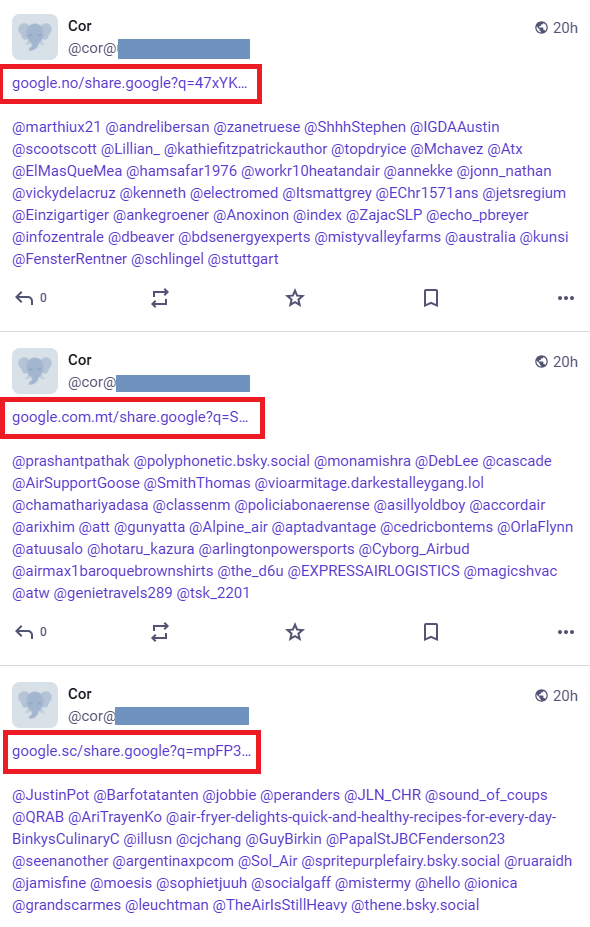
There is a spate of #AccountTakeover underway.
Service providers may receive reports for accounts that have a display name beginning with "Hacked -" or linking to "t[.]me/HomeFucker5"
These accounts may be longstanding valid accounts that have been hijacked.
While investigating, consider
The Digital Markets Act (DMA) is EU legislation aimed at curbing the power of dominant digital platforms, known as gatekeepers, by enforcing obligations that promote fairness and competition. These rules have been fully in effect since March 2024.
The European Commission is now reviewing the DMA’s impact, with a report due by May 2026. A public consultation now invites input from those most affected, including SMEs, civil society, and end users. Key areas under review include the effectiveness of the rules, their impact on users, and whether interoperability obligations should be expanded to cover social networking services.
In our response, IFTAS welcomes the progress made so far in addressing the dominance of powerful digital platforms. The current interoperability requirements for messaging services are a positive step, but they leave out a crucial part of the online experience: social networking.
At present, the DMA does not require the largest platforms to allow interoperability across core social networking functions. This includes timelines, follower relationships, and public content engagement. As a result, users are effectively locked into closed systems. If they wish to move to another service, they must leave behind their connections, visibility, and data.
We believe this is a missed opportunity to support fair competition, user choice, and digital rights.
Our submission recommends that the Commission extend Article 7 of the DMA to cover social networking services, using open technical standards such as ActivityPub and Matrix. These standards are already in use across federated platforms.
These platforms are often home to marginalised communities, mutual aid groups, and other public interest networks that rely on decentralised and safer alternatives to mainstream services. Without meaningful interoperability, these open networks remain cut off from the dominant platforms.
This reinforces existing power imbalances and prevents smaller services from reaching wider audiences. It also raises the cost of switching for users who want to leave exploitative platforms but cannot take their networks with them.
We also emphasise that interoperability must be implemented with clear safeguards. These should include strong protections for content moderation, user consent for data sharing, and measures to prevent harassment and abuse across connected services.
A more diverse and inclusive digital environment is already possible. Open standards and federated platforms show that a healthier ecosystem can exist, one that supports safety, transparency, and genuine competition. With stronger obligations in the DMA, the European Commission has the chance to make this a reality.
Our response is below.
IFTAS Submission to the DMA Review Consultation
re: https://ec.europa.eu/eusurvey/runner/Consultation_Review_DMA
Obligations (Articles 5–7, 11, 14, 15)Question: Do you have any comments or observations on the current list of obligations that gatekeepers have to respect?
The current obligations under Article 7, focused on interoperability for number-independent interpersonal communications services, represent an important step toward platform accountability. However, they fall short in addressing interoperability across core social networking functionalities, such as feeds, follower relationships, and public content interactions.
We recommend extending Article 7 to include interoperability obligations for gatekeepers offering social networking services, using open standards such as ActivityPub (https://www.w3.org/TR/activitypub/ – a Recommendation of the World Wide Web Consortium [W3] 23 January 2018). These standards already (https://ngi.eu/impact-stories/decentralised-social-media/) enable safe, decentralised communication across a federated ecosystem, as demonstrated by Mastodon, PeerTube, Pixelfed, and other open platforms (https://en.wikipedia.org/wiki/ActivityPub#Software_using_ActivityPub). The absence of interoperability in this domain enables entrenched gatekeepers to consolidate user attention and restrict market access. Platforms with dominant social graphs and proprietary content ranking systems benefit from network effects that create structural barriers to entry for new or smaller services. This stifles innovation and reduces consumer choice in the online communications space.
Obligations, General CommentsQuestion: Do you have any other comments in relation to the DMA obligations?
IFTAS recommends that gatekeepers be required to:
Without such obligations, the core social networking layer remains closed and non-contestable. Users cannot easily switch providers without losing their connections, reach, and history – all of which gatekeepers use to maintain lock-in. Additionally, without protocol-based competition, the market tilts toward scale and surveillance, rewarding platforms that exploit user data most efficiently. This creates a race to the bottom in terms of transparency, accountability, and platform governance. In contrast, open standards foster an ecosystem of diverse service models – including non-profit, cooperative, academic, and small business platforms – that can operate interoperably, safely, and competitively.
Effectiveness and ImpactQuestion: Do you have any concrete examples on how the DMA has positively and/or negatively affected you/your organisation?
IFTAS supports decentralised online platforms and self-governed digital spaces. While the DMA’s provisions on messaging interoperability are a positive signal, the ongoing exclusion of core social networking functions from interoperability obligations remains a barrier.
For example, Mastodon and PeerTube platforms often host critical infrastructure for marginalised communities and mutual aid networks, yet remain disconnected from dominant gatekeeper platforms. Users who wish to migrate from a non-interoperating platform to a an open, federated platform cannot bring their social graph or maintain connections with their existing audience. Content posted in open, standards-compliant systems cannot be discovered or engaged with by users on major platforms, despite technical feasibility. Platform switching costs remain prohibitively high due to the lack of reciprocal interoperability. This reinforces monopolistic dynamics and discourages competition based on quality, safety, and trust, instead rewarding incumbents who control data flows and visibility algorithms.
Additional CommentsQuestion: Do you have any further comments or observations?
IFTAS encourages the European Commission to take a leadership role in advancing interoperability by design, through:
To ensure safety and human rights are upheld, we also recommend the inclusion of safeguards to:
A future-ready DMA must not only limit market power, but also ensure that digital public infrastructure remains plural, rights-respecting, and inclusive. Expanding the DMA’s interoperability provisions would promote greater market diversity, reduce systemic dependencies on dominant actors, and enable a healthier, more dynamic digital public sphere.
We are excited to announce that @ted@an.errant.cloud and @andresmh@hci.social have joined the IFTAS Advisory Board!

Ted is a distinguished leader in open-source technology and digital public interest work. With his deep expertise in fostering privacy, transparency, and ethical tech practices, Ted brings invaluable insight to our mission of building safer, more equitable digital spaces.
Ted’s career spans pivotal roles in both corporate and nonprofit sectors, with a particular focus on open-source solutions that empower users and prioritize ethical use of data. As Director of Product at Mozilla, he led projects that promote user privacy and responsible tech development. Before Mozilla, Ted was the CEO of DocumentCloud, where he helped investigative journalists access critical information through open-source tools that strengthened transparency in the media landscape.

Andrés leads multidisciplinary research teams that build and study technologies designed to help people connect and collaborate in new ways. He is the director of the Human-Computer Interaction Lab at Princeton and an assistant professor in Princeton’s Department of Computer Science. He also serves on the board of Crisis Text Line. Andrés and his team have created and deployed social technologies used by millions of people, including the Scratch web site—an award-winning online community for children to learn programming.
At IFTAS, we are committed to creating a decentralised social internet that is safe and inclusive. Andrés and Ted bring a wealth of experience in trust, safety, and decentralised technologies to help steer our initiatives. In joining the advisory board, they will offer strategic guidance on key projects, including our ongoing efforts to develop a robust content classification service for detecting and mitigating harmful content in the Fediverse.
We are thrilled to welcome Andrés and Ted to our team, and we look forward to the exciting collaborations ahead as we continue working toward a safer, more just digital world.




 ⁂