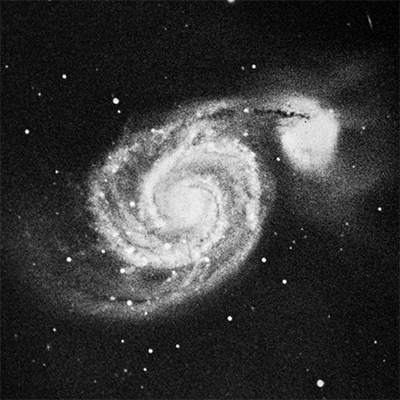
Kitt Peak National Observatory image of Arp 336, also known as NGC 2685.
NGC 2685 is a polar ring galaxy. It has a ring of gas, stars, and dust that orbits perpendicular to the plane of the galaxy, seen as unusual whorls, or helical filaments. These structures likely formed through an interaction which captured material from another galaxy.
Credit: NOIRLab, AURA, NSF
Source: https://noirlab.edu/public/images/noao-n2685/
#ArpGalaxy #Galaxy #Space #Astronomy
#arpgalaxy
3 posts · Last used 14d
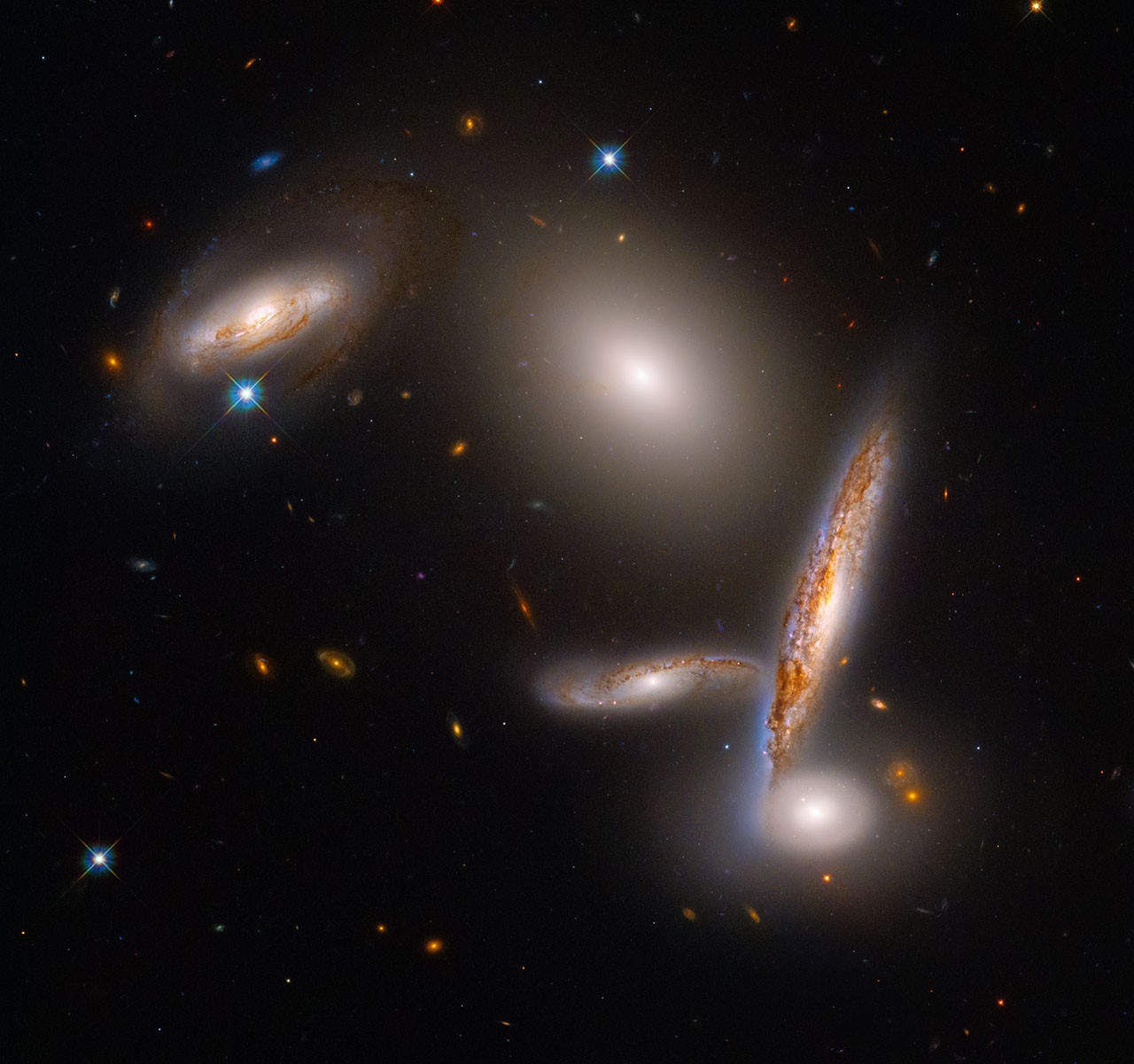
Hubble image of Arp 321, also known as Hickson 40.
This group of galaxies include three spiral galaxies, an elliptical galaxy, and a lenticular (lens-like) galaxy. The group is so compact it could fit within a region of space that is less than twice the diameter of our Milky Way's disk.
Credit: NASA, ESA, STScI, A. Pagan
Source: https://science.nasa.gov/asset/hubble/hickson-compact-group-40/
#ArpGalaxy #Galaxy #Space #Astronomy #Hubble
Spitzer image of Arp 188, also known as the Tadpole Galaxy.
The Tadpole is a result of a recent galactic interaction. A small intruder galaxy distorted the larger galaxy's shape, creating a 280,000 light-year-long tail of stars and gas.
Credit: NASA/JPL-Caltech/C. Lonsdale (IPAC/Caltech), SWIRE Team
Source: https://www.spitzer.caltech.edu/image/sig05-019b-spitzer-swire-view-of-the-tadpole-galaxy
#ArpGalaxy #Galaxy #Space #Astronomy
You've seen all posts

