
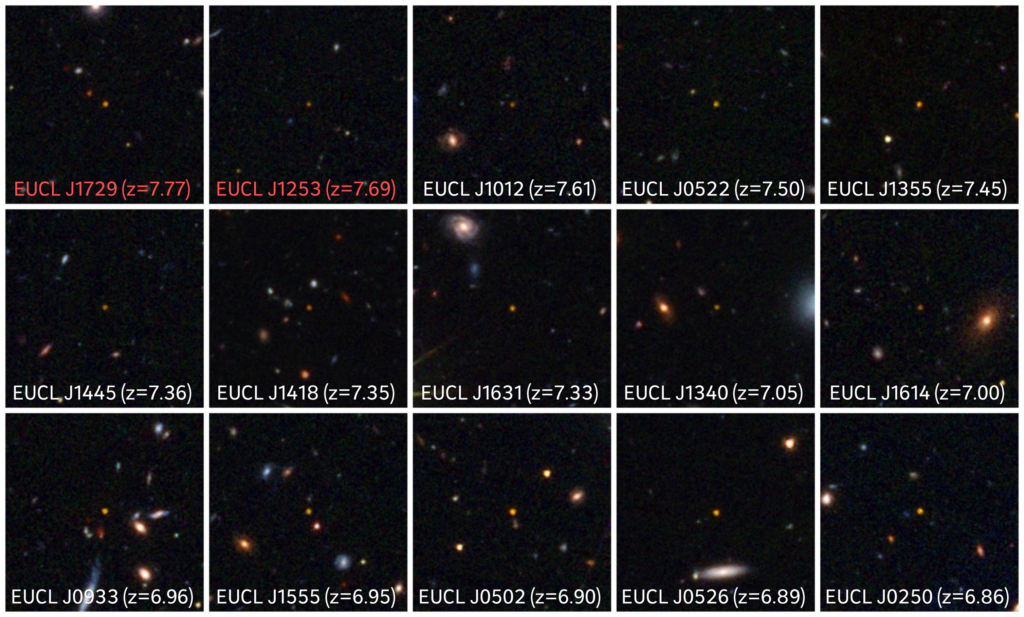
#Euclid scientists identified 31 new early Universe quasars, including the two most distant quasars currently known. The new record holder's redshift z=7.77 places it only 670 million years after the Big Bang.
https://www.euclid-ec.org/most-distant-quasars/
#ESA #ESAEuclid #astronomy #blackholes #science
#euclid
4 posts · Last used Jul 19
Replying to
With this first collection, #Euclid starts dominating the search for early Universe #quasars. This is no wonder: Euclid's wide survey provides unprecedented sensitivity at wavelengths into the near-infrared, which are key to identifying these rare accreting early black holes.
Forecasts predict that in Euclid data even earlier quasars should be found: likely beyond z=8 (650 million years after the Big Bang) and possibly even z=9 (550 million years).
#astronomy #ESAEuclid #ESA #blackholes
Replying to
Le télescope spatial #Euclid vient de réaliser la plus grande image haute résolution jamais obtenue du cœur de notre galaxie en lumière visible. En seulement 26 heures d'observation, Euclid a assemblé une mosaïque couvrant une portion du ciel équivalente à plus de 20 pleines Lunes vues depuis la Terre.
Believe me, you need this bit of space ASMR today:
https://www.youtube.com/watch?v=2DtFRq1cgcc
Background info:
▶️ https://www.esa.int/Science_Exploration/Space_Science/Euclid/ESA_s_Euclid_captures_the_Milky_Way_s_crowded_heart
You are looking at the largest and most detailed image ever made of our Milky Way galaxy’s centre in visible light.
Scientifically, the data will be used for microlensing surveys to find exoplanets - and is now fully publicly available. As are the pretty images if you want them as a desktop backgrounds, of course!
#ESA #Euclid #space #astronomy #astrodon
Euclid captures the Milky Way’s crowded heart
You've seen all posts