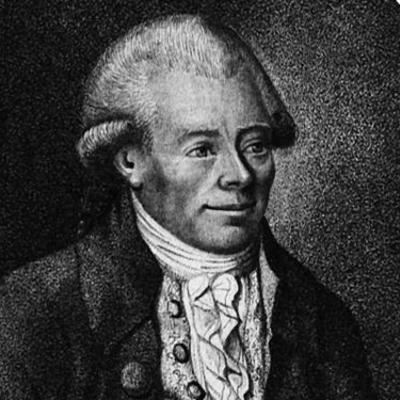
Georg Christoph Lichtenberg (July 1, 1742 – February 24, 1799) , scientist, philosopher, writer. The entries here come from: Lichtenberg, Georg Christoph, and Norman Alliston. The Reflections of Lichtenberg. Selected and Translated by Norman Alliston. 1908.
Georg Christoph Lichtenberg
Georg Christoph Lichtenberg (July 1, 1742 – February 24, 1799) , scientist, philosopher, writer.
The entries here come from:
Lichtenberg, Georg Christoph, and Norman Alliston. The Reflections of Lichtenberg. Selected and Translated by Norman Alliston. 1908.
Posts
Georg Christoph Lichtenberg (July 1, 1742 – February 24, 1799) , scientist, philosopher, writer. The entries here come from: Lichtenberg, Georg Christoph, and Norman Alliston. The Reflections of Lichtenberg. Selected and Translated by Norman Alliston. 1908.
I can imagine the time when our present religious ideas will appear as singular as the ancient spirit of chivalry does in our day.
Georg Christoph Lichtenberg (July 1, 1742 – February 24, 1799) , scientist, philosopher, writer. The entries here come from: Lichtenberg, Georg Christoph, and Norman Alliston. The Reflections of Lichtenberg. Selected and Translated by Norman Alliston. 1908.
If only the tenth part of the religion and the morals that are in books existed in the heart! But what almost universally happens is that the greater part of human wisdom, soon after its production, is laid to rest in repositories. Hence it was once suggested that this word must be derived, not from the Latin reponere, but direct from the French repos.
Georg Christoph Lichtenberg (July 1, 1742 – February 24, 1799) , scientist, philosopher, writer. The entries here come from: Lichtenberg, Georg Christoph, and Norman Alliston. The Reflections of Lichtenberg. Selected and Translated by Norman Alliston. 1908.
With most people unbelief in one thing is founded upon blind belief in another.
Georg Christoph Lichtenberg (July 1, 1742 – February 24, 1799) , scientist, philosopher, writer. The entries here come from: Lichtenberg, Georg Christoph, and Norman Alliston. The Reflections of Lichtenberg. Selected and Translated by Norman Alliston. 1908.
How ever can mankind have come by the idea of liberty? It was a grand thought!
Georg Christoph Lichtenberg (July 1, 1742 – February 24, 1799) , scientist, philosopher, writer. The entries here come from: Lichtenberg, Georg Christoph, and Norman Alliston. The Reflections of Lichtenberg. Selected and Translated by Norman Alliston. 1908.
I and myself. I feel myself—these are two distinct things. Our false philosophy is incorporated in our whole language; we cannot reason without, so to speak, reasoning wrongly. We overlook the fact that speaking, no matter of what, is itself a philosophy.
Georg Christoph Lichtenberg (July 1, 1742 – February 24, 1799) , scientist, philosopher, writer. The entries here come from: Lichtenberg, Georg Christoph, and Norman Alliston. The Reflections of Lichtenberg. Selected and Translated by Norman Alliston. 1908.
For a long while I was unable to make out how it is that the books of certain celebrated polygraphic authors are so terribly tiring to read; but at length I hit upon the reason: it comes from the fact that in comparison with really great men these people are so insignificant that we have no interest whatever to know what they know.
Georg Christoph Lichtenberg (July 1, 1742 – February 24, 1799) , scientist, philosopher, writer. The entries here come from: Lichtenberg, Georg Christoph, and Norman Alliston. The Reflections of Lichtenberg. Selected and Translated by Norman Alliston. 1908.
Is it, then, quite so certain that human reason can have absolutely no knowledge of what transcends the senses? Might not man be capable of weaving his ideas about God just as appropriately as the spider its web for catching flies? Or in other words, might there not be beings who as much marvel at us, on account of our theories about God and immortality, as we at the spider and the silkworm?
Georg Christoph Lichtenberg (July 1, 1742 – February 24, 1799) , scientist, philosopher, writer. The entries here come from: Lichtenberg, Georg Christoph, and Norman Alliston. The Reflections of Lichtenberg. Selected and Translated by Norman Alliston. 1908.
When you see anything big ask yourself, "What is this in little?" and with little things ask, "What is this in big? Where is this to be found in big or in little?"-It is also a good plan to consider everything in as generalized a form as possible, and invariably to bring to mind the whole of the the chain, from top to bottom, of which anything is a link. Every object makes part of some such chain, the extremes of which hardly seem to belong to each other.
Georg Christoph Lichtenberg (July 1, 1742 – February 24, 1799) , scientist, philosopher, writer. The entries here come from: Lichtenberg, Georg Christoph, and Norman Alliston. The Reflections of Lichtenberg. Selected and Translated by Norman Alliston. 1908.
What I dislike in the method of treating history is that people see purpose in every action and trace every event to some intention or other. That is assuredly all wrong. The greatest events come to pass without any design; chance makes blunders good, and amplifies the most cleverly-laid scheme. The important events in the world are not deliberately brought about; they occur.
Georg Christoph Lichtenberg (July 1, 1742 – February 24, 1799) , scientist, philosopher, writer. The entries here come from: Lichtenberg, Georg Christoph, and Norman Alliston. The Reflections of Lichtenberg. Selected and Translated by Norman Alliston. 1908.
By our constant reading we not only accustom ourselves to take things for true which are not so, but the proofs advanced also assume a form which is often demanded not so much by the nature of the case as by our own unconscious adherence to convention.
Georg Christoph Lichtenberg (July 1, 1742 – February 24, 1799) , scientist, philosopher, writer. The entries here come from: Lichtenberg, Georg Christoph, and Norman Alliston. The Reflections of Lichtenberg. Selected and Translated by Norman Alliston. 1908.
I am convinced-at any rate according to the ideas which I myself have formed of the capacity of the human mind—that even with all the approximations in our analysis things will one day go better. It is this improving of beaten paths that delays intellectual progress. New paths! -- that is what must be the word, if posterity is to believe that progress was foreseen.
Georg Christoph Lichtenberg (July 1, 1742 – February 24, 1799) , scientist, philosopher, writer. The entries here come from: Lichtenberg, Georg Christoph, and Norman Alliston. The Reflections of Lichtenberg. Selected and Translated by Norman Alliston. 1908.
After all, is our idea of God anything more than personified incomprehensibility?
Georg Christoph Lichtenberg (July 1, 1742 – February 24, 1799) , scientist, philosopher, writer. The entries here come from: Lichtenberg, Georg Christoph, and Norman Alliston. The Reflections of Lichtenberg. Selected and Translated by Norman Alliston. 1908.
There are people who can come to no decision on any matter without having first slept over it. This is all very well; but cases may occur where on this plan you risk being captured, bed and all.
Georg Christoph Lichtenberg (July 1, 1742 – February 24, 1799) , scientist, philosopher, writer. The entries here come from: Lichtenberg, Georg Christoph, and Norman Alliston. The Reflections of Lichtenberg. Selected and Translated by Norman Alliston. 1908.
So long as we think that we can credit ourselves with some subtle application of a knowledge of human nature, and imagine that only the initiated are capable of such penetration into others' hearts, we are loth to give up false opinions about people. There are in consequence few branches of human knowledge in which half-knowledge does more mischief than in this one.
Georg Christoph Lichtenberg (July 1, 1742 – February 24, 1799) , scientist, philosopher, writer. The entries here come from: Lichtenberg, Georg Christoph, and Norman Alliston. The Reflections of Lichtenberg. Selected and Translated by Norman Alliston. 1908.
Truly to express what is truly felt -— that is, to express oneself with those little touches which attest personal emotion -- is really what makes a great writer; common ones invariably use phrases which are no better than second-hand clothes.
Georg Christoph Lichtenberg (July 1, 1742 – February 24, 1799) , scientist, philosopher, writer. The entries here come from: Lichtenberg, Georg Christoph, and Norman Alliston. The Reflections of Lichtenberg. Selected and Translated by Norman Alliston. 1908.
Put it how you will, philosophy is only the art of discrimination. The country bumpkin makes use of all the principles of philosophy, though indirectly, latently, or in combination, as the physicist and chemist would say; the philosopher gives us them pure.
Georg Christoph Lichtenberg (July 1, 1742 – February 24, 1799) , scientist, philosopher, writer. The entries here come from: Lichtenberg, Georg Christoph, and Norman Alliston. The Reflections of Lichtenberg. Selected and Translated by Norman Alliston. 1908.
Undoubtedly a certain truth, and therefore a certain utility, underlies religious hatred. I really wish that it could be discovered. Our philosophers talk of religious hatred as of something that could be reasoned away; but this it assuredly cannot be.
Georg Christoph Lichtenberg (July 1, 1742 – February 24, 1799) , scientist, philosopher, writer. The entries here come from: Lichtenberg, Georg Christoph, and Norman Alliston. The Reflections of Lichtenberg. Selected and Translated by Norman Alliston. 1908.
There are people who can believe anything they wish. What lucky creatures!
Georg Christoph Lichtenberg (July 1, 1742 – February 24, 1799) , scientist, philosopher, writer. The entries here come from: Lichtenberg, Georg Christoph, and Norman Alliston. The Reflections of Lichtenberg. Selected and Translated by Norman Alliston. 1908.
What am I? What ought I to do? What may I hope and believe? To this everything in philosophy may be reduced. It were to be wished that other things might be thus simplified; at least we ought to try whether everything that we intend to treat of in a book cannot at once be so epitomized.
Georg Christoph Lichtenberg (July 1, 1742 – February 24, 1799) , scientist, philosopher, writer. The entries here come from: Lichtenberg, Georg Christoph, and Norman Alliston. The Reflections of Lichtenberg. Selected and Translated by Norman Alliston. 1908.
A man ought never to say to himself: “ This subject is beyond me; it is one for an expert; I had better turn to something simpler." To do so is a weakness that may easily degenerate into complete inactivity. There is no subject for which we ought to consider ourselves not good enough.