#agile

42 posts · Last used 5d

Back to Timeline
Thomas ◉ measure flow @nobsagile@mastodon.social · 5d ago
Prioritäten sind kein Steuerungsinstrument. Sie sind eine Momentaufnahme davon, wer zuletzt laut war: Chef, Kunde, Support. Deshalb ist die Liste am Montag schon falsch. Nicht weil ihr schlecht priorisiert, sondern weil sich die Lage bewegt und die Liste nicht. Eisenhower hat das sauber getrennt: „Plans are nothing, planning is everything." Der Plan ist Abfall. Das Planen nicht. https://no-bullshit-agile.de/die-illusion-von-prioritaeten-warum-sie-uns-einschraenken-und-agiles-handeln-behindern.html?mtm_campaign=mastodon #Agile #Leadership #Kanban
2
0
1
Thomas ◉ measure flow @nobsagile@mastodon.social · Jul 29, 2026
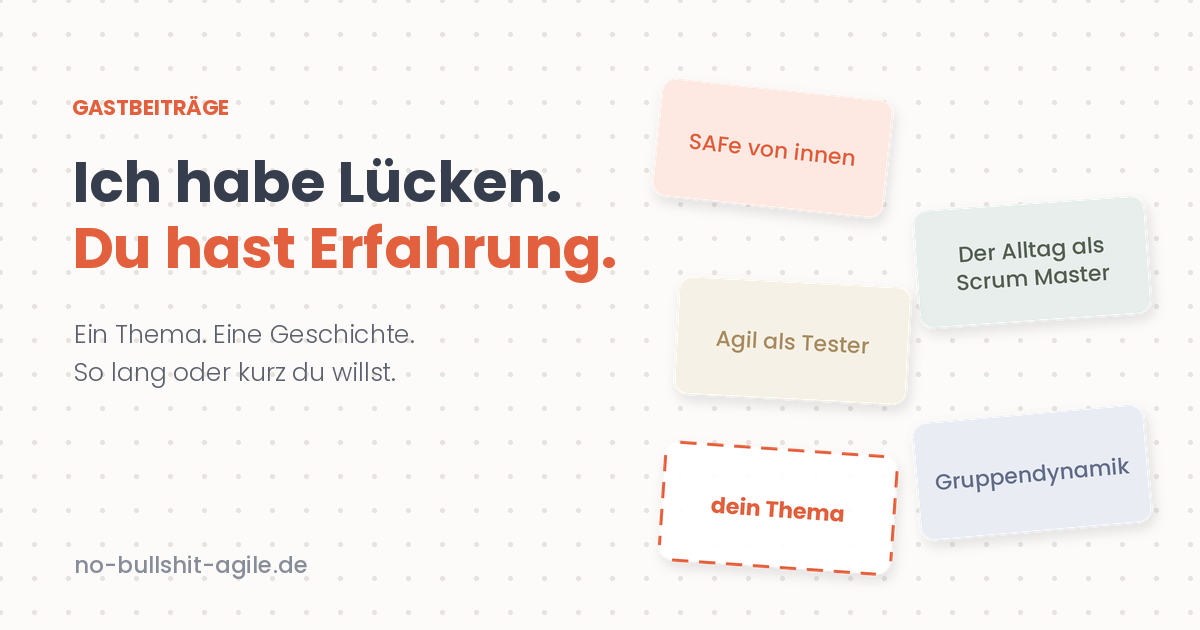
Ich schreibe hier über agiles Arbeiten. Über manches kann ich nicht schreiben, weil ich es nicht erlebt habe. SAFe von innen. Der Alltag als Scrum Master. Agiles Arbeiten als Tester. Agil außerhalb der Softwareentwicklung. Schreib einen Gastbeitrag bei mir. Kein Wortlimit, kein Konzept, kein SEO. Eine Erfahrung in eine Mail getippt reicht. Struktur und Formatierung mache ich. Autorenbox mit deinen Links gibt's dazu. Boost, please! https://no-bullshit-agile.de/ich-habe-luecken-du-hast-erfahrung.html #Agile #Scrum #Kanban #Blog
6
1
5
Open Security Conference @OSCo@infosec.exchange · Jul 27, 2026
Replying to @OSCo@infosec.exchange
His tags: #infosec, #agile, #systemsthinking Thank you very much for your work as a volunteer and your support in organizing the Open Security conference
2
1
1
Thomas ◉ measure flow @nobsagile@mastodon.social · Jul 26, 2026
4 days in, #AgileConfessions has some gems: "I misused the daily as a status report." "I thought agile meant finishing tickets fast so I could change the plan anytime." "Endless upfront plans, until I learned to run experiments." Your turn: the most anti-agile thing you've done, and what it taught you. Any language, just tag #AgileConfessions. #softwaredevelopment #agile #scrum #kanban
3
0
1
Mike Bowler @mike_bowler@hachyderm.io · Jul 23, 2026
JiraMetrics v3.0 is out. It's a free, open-source command-line tool that turns your Jira history into agile metrics charts (cycle time, aging WIP, throughput, and more) in one self-contained HTML report. Useful for any team that wants to understand and improve its delivery flow. A major release because it now requires Ruby 3.4 (or JRuby 10) and removes long-deprecated features. Full change log at https://jirametrics.org/changes/ #agile #jira #flowmetrics #kanban #scrum
0
0
0
Italian News by RSS @ItalianNews@mastodon.ozioso.online · Jul 23, 2026
Today: How the EU aims to accelerate the development of new military technologies Grants awarded within four months, faster access to testing and certification, direct links with major defence companies and simpler procurement procedures. These are the main features of AGILE, the new 115 million euro programme that Brussels hopes will use to strengthen the armed forces of EU... How the EU intends to speed up the development of new military technologies Grants awarded within four months, faster access to testing and certification, direct links with major defense companies and simpler procurement procedures. These are the main features of AGILE, the new €115 million program that Brussels hopes will use to strengthen the armed forces of the EU… #AGILE #Brussels https://www.today.it/europa/en/eu-accelerate-development-military-technologies.html
0
0
0
Italian News by RSS @ItalianNews@mastodon.ozioso.online · Jul 23, 2026
Today: Così l'Ue punta ad accelerare lo sviluppo delle nuove tecnologie militari Sovvenzioni in quattro mesi, accesso più rapido a collaudi e certificazioni, collegamenti diretti con i grandi gruppi industriali della difesa e procedure più semplici per gli appalti. Sono queste le principali novità del programma Agile, il nuovo strumento da 115 milioni di euro su cui Bruxelles... So the EU aims to accelerate the development of new military technologies. Grants in four months, faster access to inspections and certifications, direct links with major defense industrial groups, and simpler procedures for tenders. These are the main innovations of the Agile program, the new €115 million tool on which Brussels… #Agile #Brussels https://www.today.it/europa/deep/ue-accelerare-sviluppo-nuove-tecnologie-militari.html
0
0
0
Thomas ◉ measure flow @nobsagile@mastodon.social · Jul 04, 2026

"Agilität ist tot." und was ist die Alternative? Zurück zum Wasserfall?

Nicht die Agilität ist tot. Ein Zerrbild ist tot:

  • Fake Agile: Scrum ohne Verständnis der Basis
  • Dark Agile: agiler Deckmantel, drunter reines Top-down
  • Kommerzialisierung: Zertifikatsflut, überladene Komplexität

Das Label ist verbrannt. Das Handwerk fängt gerade erst an: Iteration + Feedback.

https://no-bullshit-agile.de/nbak08-warum-agilitaet-nicht-tot-ist.html

#Agile #Agilität #Scrum #Kanban #AgilesArbeiten

0
0
0
bash2 @bash2@momou.social · Jul 02, 2026
No comment. (Got it from someone over bsky.) #VibeCoding #Programming #Agile
6
0
9
Thomas ◉ measure flow @nobsagile@mastodon.social · Jul 03, 2026
"Wann ist das Projekt fertig?" Die Frage klingt vernünftig. Ist sie aber nicht. Niemand kann sie ehrlich beantworten, weil das Team erst während des Projekts lernt, was das Projekt überhaupt ist. Jeder fixe Komplett-Plan tut nur so, als wäre die Zukunft schon bekannt. Plan klein, liefer früh, lass Feedback den Rest planen. #Projektmanagement #agile #scrum #kanban
0
0
0
Trond Hjorteland @trondhjort@hachyderm.io · Apr 07, 2026
I managed to make a little dent with my series of posts on #SocioTechnical principles of the day, and thought it was due to do something similar, but this time in the context of modern organisations (especially #agile ones) and the modern version of #STS, known as Emery's #OpenSystemsTheory ( #OST). I'll list some systemic problems I have seen in organisations over the years and explain their causes using OST, one each day as I did back then. Probably way too ambitious, but let's see how this goes. Happy to take comments and rebuttals to each one of them, as the point of doing this is to trigger reflections and critical thinking. Warning: these will probably be a bit more opinionated. 😁 Organisational Dysfunction of the Day The daily status report Context: Your team is using Scrum and has been taught how important stand-ups are (daily coordination meeting), but it feels like a drag and a complete waste of time. Feels more like reporting to someone, be it the scrum master or the product owner. And you really do not care about what the others are working on, as it has little to no impact on what you're doing. OST explains: This team is probably not a team at all; it's more like a group of individuals working on different things. They may contribute to the same delivery but have not been able to take control of the work design and the coordination needed to deliver it. This is not a self-managing team, but rather a delivery group assigned specific tasks by a manager, in charge of splitting the work so that all team members are working as effectively as possible. This is pure DP1 and nowhere close to the self-managing teams in DP2.
46
0
23
Trond Hjorteland @trondhjort@hachyderm.io · Apr 09, 2026
Replying to @trondhjort@hachyderm.io
Organisational Dysfunction of the Day The powerless retrospective Context: You and your team have decided it's time to do a retrospective prescribed by the Agile methodology you are using. You all see the use of it and contribute with a lot of ideas and concerns about your work. You record them all and have a vote on the most important ones, but soon realise almost all of them are outside of your mandate to change. You note them down and hope the department lead can do something about it, but know that probably nothing will change, and the whole exercise feels like a complete waste. OST explains: The members of the team come into this believing they are self-managing, at least to a level where they are able to adjust the work to make it better. Even the Agile methodology says so by incorporating the retospective as a recommended element. An essential element in learning is both looking back and improving going forward. The issue here is that the team is not self-managing, in a DP2 structure, as they are not able to change what really matters to them. Most likely, they are in an agile setup where the teams have been given some control, but most still reside in management outside, in the existing bureaucratic DP1 organisation. The retrospective and the learning it ought to provide are mostly ineffective. #OpenSystemsTheory #SocioTechnical #agile
10
0
4
Trond Hjorteland @trondhjort@hachyderm.io · Apr 13, 2026
Replying to @trondhjort@hachyderm.io
Organisational Dysfunction of the Day Forming–storming–norming–performing Context: When putting together a new team or making big changes to an existing one, many recommend using Tuckman's "forming–storming–norming–performing" model to turn the team into a coherent and well-oiled unit. It begins with Forming (orientation), moves to Storming (conflict), progresses to Norming (cohesion), and ends with Performing (high productivity). Leaders are advised to manage this process closely as progress is not linear; teams may slip back to previous stages if new members join or goals shift. And conflict is regarded as necessary, as the "Storming" phase is essential to growth. OST explains: Tuckman's model only makes sense in an autocratic bureaucracy, especially those of the Theory X type, and aligns with Taylor's view that people must be managed to perform properly. This is classic DP1 thinking, whereas in the DP2 style, McGregor's Theory Y is the model, which assumes employees are self-motivated, enjoy work, and thrive under trust, empowerment, and autonomy. Grouped into self-managing groups that have designed themselves using Participative Design. No need for either storming or norming; the teams jump right to performing after forming. #OpenSystemsTheory #SocioTechnical #OrgDesign #agile
10
0
6
Trond Hjorteland @trondhjort@hachyderm.io · Apr 14, 2026
Replying to @trondhjort@hachyderm.io
Organisational Dysfunction of the Day Analysis paralysis Context: An agile team is working on a rewrite of an existing legacy solution and feels that its success depends on the function parity it must have with the old one. They therefore end up doing a detailed and extensive analysis to account for as much as possible, even tracking down former developers to get details on some of the more obscure parts. And, even more problematic, they have to figure out which business people own which parts and who all their users are. This drags out in time, and although they have started the work, the extensible analysis prevents them from releasing anything. They are stuck. OST explains: Agile as a concept is pretty much designed to handle these kinds of situations; at least that is what many may think. It focuses on small increments and puts things in front of the users as soon as possible to tighten the feedback loop, so it makes sense. The thing, though, is that this is not product discovery, as it is an existing product with external product owners and users, both internal and external, and the team has no real product ownership of the app apart from the technical bits. They are not a self-managing product team as a DP2 style should be. Only when they have end-to-end ownership of the whole product, not just a part, can they take full responsibility and accountability so that they can manage it as they please. #OpenSystemsTheory #SocioTechnical #OrgDesign #agile
5
0
1
Trond Hjorteland @trondhjort@hachyderm.io · Apr 15, 2026
Replying to @trondhjort@hachyderm.io
Organisational Dysfunction of the Day Individualism Context: Often, there is a large disproportion in how much people are celebrated for their achievements and when blame is placed for accountability when something goes wrong. This feels natural in most parts of the world, as we want to take care of the people and make them feel as good as possible so that they'll feel well and stick around. Being human, as we say. Even toward the people who clearly take on the accountability, and are even paid good money to do so, often leading to few or no consequences. We value the individual when celebrations are due, when heroes are praised, but hide them when there is not. Typically, hero cultures are also a power play, as the ones praised become stretch goals for the rest, showing what lengths they have to go to feel respected and truly valued. OST explains: This focus on the individual is almost anathema in OST, not because the individual is not valued, but it realises that the group is the basic unit of life, be it your family, your friends or your colleagues. It's founded on the belief that people have both the need for autonomy and homonomy; be able to self-govern and fit in with the group. Actually, valuing individuality as an acontextual thing hides a vital paradox, as it inevitably isolates people as the problem because there is nothing else to blame. It even goes beyond blaming the victim; it creates them. By instead focusing on the group, and having it take responsibility and accountability, it can take both the praise AND the blame. The individual is protected in the group, and it can jointly grow and learn from successes and failures. As it takes them to their shared goals.  #OpenSystemsTheory #SocioTechnical #OrgDesign #agile
6
0
4
Trond Hjorteland @trondhjort@hachyderm.io · Apr 16, 2026
Replying to @trondhjort@hachyderm.io
Organisational Dysfunction of the Day Quiet quitting Context: During the COVID-19 pandemic, many things were exacerbated in the population, including how people feel about work. A major trend in America was referred to as the Great Resignation, in which many cited the quality of work as a reason for leaving. Another trend that surfaced about the same time was Quiet Quitting, where employees who are fulfilling their job requirements, but not taking initiative, working overtime or volunteering for extra projects or responsibilities. In short, people are not engaged at work, something the Gallup's State of the Global Workplace report confirms, saying that only 20% of are engaged and 16% are actively disengaged. So not only are sick leaves and absenteeism a problem; when people are at work, just a small minority are actually enjoying it. OST explains: The reason for these dreadful numbers drops right out of OST and all the research it builds on since the 1950s. Given that the extrinsic motivators for work are satisfactory, such as security, work hours, and pay, the defining reasons for people enjoying work are how well their intrinsic motivators are being fulfilled. A minimal set of six psychological job requirements is the basis and they measure how well a job design works, be it the processes, the technology, the organisation, or the colleagues. If people score well on things like ownership, learning on the job, variety, support and respect, meaningfulness, and career path, they will not only enjoy work, be engaged and produce better results; they will also get a better quality of life. #OpenSystemsTheory #SocioTechnical #OrgDesign #agile


3
0
0
Trond Hjorteland @trondhjort@hachyderm.io · Apr 17, 2026
Replying to @trondhjort@hachyderm.io
Organisational Dysfunction of the Day Team leads Context: Most teams in modern agile organisations may not formally have a manager in the same sense as before. Many still have someone they report to as an employee, dealing with yearly reviews, career development, and any job issues, but they are not formally involved in the daily work. It should therefore be possible to have leaderless teams, where all members are peers and have the same say in everything. No ranking. Still, many teams end up being appointed a team lead, often because the organisation wants one contact point and one person in charge of the work done. Many in this position try to deal with this dissonance by taking on a coaching type role, seeing themselves as a "servant leader," giving space to the team and protecting them from the outside. Some even try to switch, being directive sometimes, supportive at other times (aka situational leadership). Not only is this a tricky job to have, but it also creates so much confusion in the team about who really decides and is in charge. OST explains: DP1-type organisations require personal leadership positions, as that is how control, coordination and alignment are managed. Agile tries to counter that for efficiency, having teams take more control of the work, in an attempt to shorten the feedback loop and the learning. This is similar to DP2, with self-organising teams, while adding team leaders is not and is an attempt to adapt them to the existing bureaucratic DP1 model. The problem with this is that DP1 and DP2 fit together like oil and water; they are fundamentally so different that no matter how good the adapters are, they will lead to confusion and operational problems. You can remove the need for this adapter by ditching DP1, having teams everywhere and letting them take responsibility for their own goals and the integration needed to work with other teams. Teams may decide to appoint a leader, though, for their own needs, either permanently or when needed, but it is not a formal position of power. It is a participative democracy through and through. #OpenSystemsTheory #SocioTechnical #OrgDesign #agile
4
0
1
Trond Hjorteland @trondhjort@hachyderm.io · Apr 20, 2026
Replying to @trondhjort@hachyderm.io
Organisational Dysfunction of the Day The company's strategy is unclear Context: "What we've got here is failure to communicate." A common quote used to describe a lack of understanding of and commitment to the company's strategy. Top management is frustrated by the lack of alignment, projects and departments not seeing the bigger picture clearly drawn up in the strategy document. At the same time, the people at the coalface constantly report back that they miss a clear and concise direction to follow when making decisions. All attempts to hold town hall meetings, clearly visible pages on their intranet, middle management sharing it frequently in their weekly status meetings, and even motivational phrases posted on the office walls seem to help. OST explains: There are many explanations for this dynamic, like a strategy not really being a strategy but rather a lofty goal that provides no clear guidance, or poor communication lines between the top and the bottom. Let's focus on something often missed instead. A strategy must make operational sense to people; it should give them a clear, relevant purpose for their work, feel relevant and relatable in a way that inspires and motivates. Cool and fancy wording is not the point, not even how and how often it is communicated, but how engaging it is. The best way is for people to take part in its creation, but that is not feasible in large organisations, so at least it must have agents in all parts of the organisation who do, someone the people trust and can relate to. This is what middle management ought to be doing: making the company strategy relevant and actionable for people. #OpenSystemsTheory #SocioTechnical #OrgDesign #agile
1
0
0
Trond Hjorteland @trondhjort@hachyderm.io · Apr 21, 2026
Replying to @trondhjort@hachyderm.io
Organisational Dysfunction of the Day Workshops not working Context: You have probably seen and even experienced being invited to workshops that you may or may not have that much interest in, but still obligated to join, and although it was carefully planned and executed by the facilitator, it still felt forced, unengaging and maybe even like a waste of time. This is an unfortunate situation as workshops are really the place where important and constructive work ought to happen, where people really feel energised and collaborate at the top of their game. Is it the participants that's the issue, or could it be something else? OST explains: It is rarely the participants who cause this issue, even when workforce engagement has reached rock bottom. Systemic problems like this have different causes, ranging from the larger structural issues of autocratic hierarchies that inhibit collaboration and put people up against each other to simply bad facilitation. Let's focus on the latter now, as that is an easier adjustment to make. Make sure the facilitators are only in charge of managing the process; they should not own the decision to run the workshop, the technique or process to use, or be involved in the content. The reason for this is that the point of a workshop is for people to own the content and the output, and any attempt to lead will result in Bion's basic assumptions: dependency on the facilitator, just doing what they're told; fight/flight, opposing the whole thing or just not participating; or creating factions that do their own thing instead. Suspect many have experienced these, and they can only be avoided by removing the leader and letting the facilitator serve the group, not the other way around. DP2 instead of DP1. #OpenSystemsTheory #SocioTechnical #OrgDesign #agile
1
0
0